Albedo: How to Zest a Lemon Without Touching the Bitter White Part?
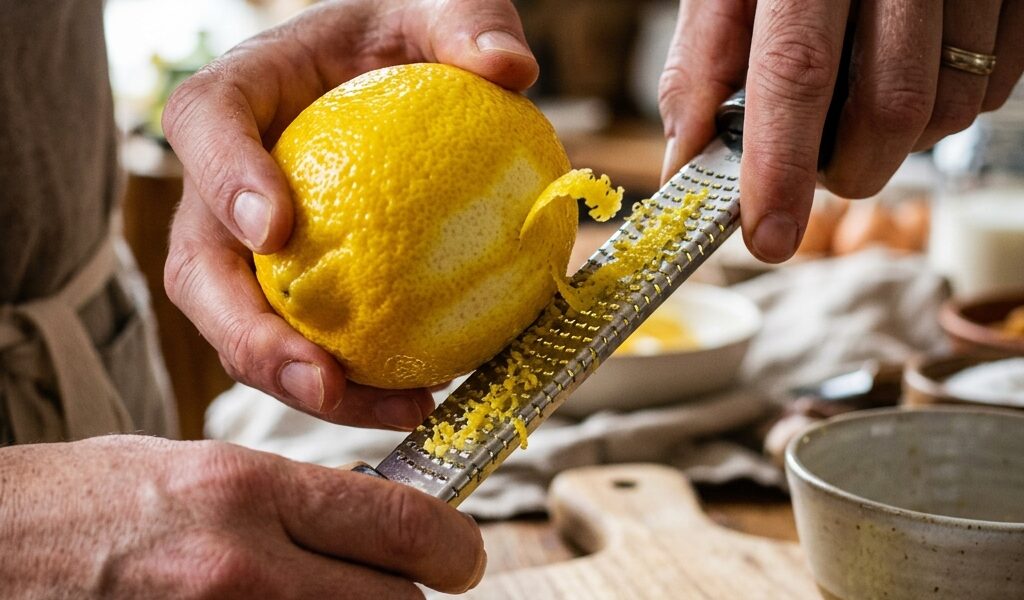
Lemon zest is one of the most aromatic and versatile ingredients in cooking and pastry. Yet behind this apparently simple gesture lies a formidable trap: the albedo. This thin, white, spongy layer located between the colored zest and the flesh of the fruit is responsible for an intense bitterness that can ruin an entire preparation. Learning to zest correctly means learning to respect the invisible boundary between aroma and bitterness.
Every home cook or professional chef who has ever grated too deeply into a lemon knows that harsh, unpleasant taste that can spoil a cream, a cake, or a sauce. The albedo is not just an aesthetic flaw: it is a plant organ in its own right, with its own chemical composition, designed by nature to protect the seeds of the citrus fruit. Understanding its structure will allow you to navigate around it with precision every time.
Mastering the art of zesting is a fundamental skill for any lemon lover in the kitchen. A good zest releases only the essential oils from the flavedo (the outer colored layer) without ever biting into the albedo. This technique is acquired through good tools and a better understanding of the fruit’s anatomical structure.
Quick Answer
To zest a lemon without touching the bitter white part (the albedo), use short, light strokes, apply minimal pressure on the grater or zester, and watch the color of the fruit as you work. As soon as you see white appearing under the yellow, you have reached the albedo. Ideally, use a fine Microplane grater, rotate the lemon a quarter turn with each pass, and never go over the same spot twice.
Scientific Explanation
The pericarp of citrus fruits (the outer part of the fruit) is structurally divided into two distinct zones: the flavedo and the albedo. The flavedo constitutes the pigmented epicarp, whose yellow color results from the presence of carotenoids (notably zeaxanthin and beta-cryptoxanthin) and, in limes, chlorophyll. It is in the flavedo that the essential oil secretory pockets are concentrated, rich in volatile terpenes such as D-limonene (60-70%), beta-pinene and citral aldehydes (neral + geranial) responsible for the characteristic lemon scent.
The albedo, on the other hand, is the spongy mesocarp located directly beneath the flavedo. It consists of a dense network of aeriferous parenchyma (cells with large vacuoles filled with air) whose physiological function is to store the nutrients needed for seed maturation and to serve as a physical barrier against pathogenic microorganisms. Biochemically, the intense bitterness of the albedo is due to a high concentration of limonoids, including limonin and nomiline. These tetracyclic terpenes belong to the family of highly oxygenated triterpenoids. Limonin intensely stimulates the bitter taste receptors of the TAS2R type (G-protein coupled receptors) present on the tongue, producing a persistent bitter sensation at concentrations as low as 1 part per million.
From a practical perspective, the flavedo/albedo boundary is approximately 1 to 2 millimeters depending on the variety and ripeness of the lemon. Thin-skinned lemons (Eureka or Lisbon varieties) require even more precision than thick-skinned varieties. The golden rule is therefore: one pass per area, light pressure, continuous movement, and systematic rotation of the fruit to evenly exploit all available flavedo.
The extraction of essential oils occurs through mechanical pressure on the secretory pockets when the grater passes over the surface. If the pressure is too strong, the grater pierces the flavedo and the first cell layers of the albedo begin to release their bitter limonoids directly into the collected zest, creating the contamination effect that makes the zest bitter.
Hands-on Experience
In a pastry workshop, I tested the taste difference between zest harvested with light pressure (flavedo only) and zest taken with heavy pressure (reaching the albedo) on identical organic lemons. The difference is spectacular: the first zest has a fresh, floral aromatic burst with a pure citrus taste. The second has a pronounced bitterness that lingers for up to 30 seconds on the palate and persists through cooking.
My standard technique: I hold the lemon in my left hand, press the Microplane grater very lightly against the fruit with my right hand, and make back-and-forth strokes of about 4 to 5 cm. I rotate the lemon a quarter turn as soon as the fruit color shifts from bright yellow to pearlescent white. With this method, I can zest an entire lemon covering 80 to 90% of its colored surface without ever touching the albedo, harvesting maximum essential oils with zero bitterness.
For beginners, I recommend zesting over a sheet of white paper to better observe the color of the zest falling off. As soon as you see white fragments mixed with the yellow, immediately stop on that area and rotate the fruit.
Conclusion
Mastering the boundary between flavedo and albedo is the key to a perfect zest, aromatic and bitterness-free. Knowledge of the biochemical composition of these two layers (essential oils in the flavedo, bitter limonoids in the albedo) explains why the lightness of the gesture is fundamental. With practice and a good tool, this technique will become a natural reflex that will permanently improve the quality of all your lemon-based preparations.