Allume-feu naturel et écologique : l’utilisation surprenante des écorces séchées
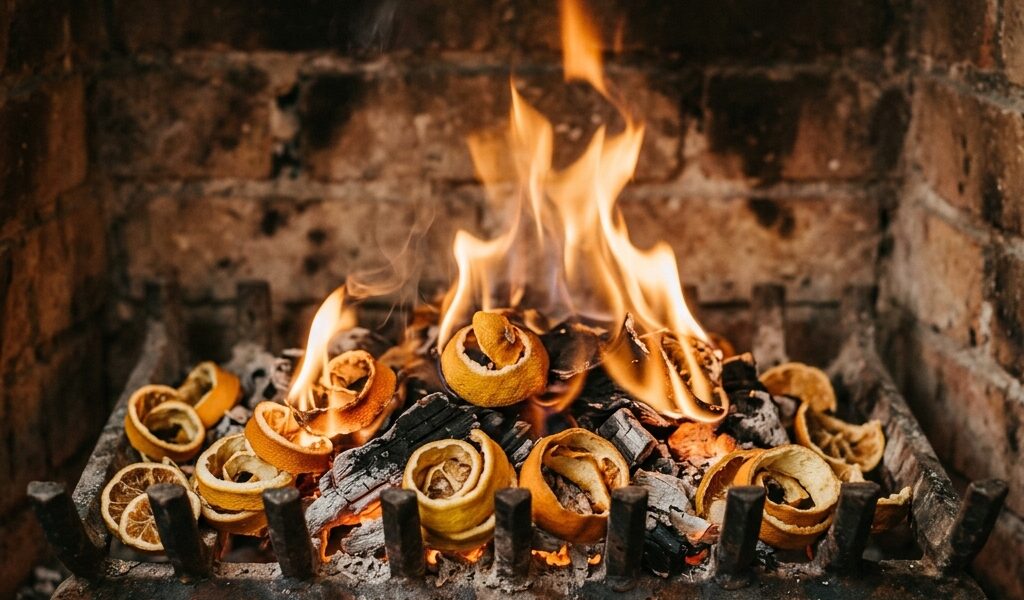
At a time when the ecological transition is finding its way into every aspect of our daily lives, reducing household waste and eliminating toxic chemical substances have become top priorities for many homes. Lighting a fire in a fireplace, wood stove, or barbecue may seem like a trivial task, yet conventional methods often rely on industrial fire starters derived from petrochemicals. These white cubes or starter liquids not only release unpleasant odors but also emit volatile organic compounds (VOCs) that are harmful to both human health and the environment. In response to this issue, the search for natural, zero-waste alternatives is gaining momentum. This is where an option as surprising as it is effective comes into play: recycling dried citrus peels. Often discarded in the trash or compost after the fruit is consumed, these peels contain exceptional physical and chemical properties that turn them into highly effective, natural fire starters. This article aims to explore the scientific foundations of this combustion process in depth, detail an optimal preparation method, and share a practical, hands-on experience.
Quick Answer
Dried citrus peels (orange, lemon, grapefruit) make excellent natural and eco-friendly fire starters due to their high concentration of d-limonene, a highly flammable chemical compound located in the secretory pockets of the flavedo (the outer peel). Once moisture is removed through drying, these peels combine this energy-dense liquid fuel (with a heat of combustion of ~45 MJ/kg) with the albedo (the white inner part), a porous cellulosic structure that acts as a natural capillary wick. This combination ensures a stable, intense, and long-lasting burn (up to 5 minutes), which is more than enough to ignite kindling without any toxic substances, while filling the air with a pleasant, fruity scent.
Scientific Explanation
To understand the combustion performance of a dried citrus peel, it is essential to analyze its histological structure and biochemical composition. The peel, or pericarp, is divided into two distinct layers: the flavedo (epicarp) and the albedo (mesocarp). The flavedo is the colored outer layer that contains numerous secretory glands or pockets of ovoid shape. These lysigenous cavities store the citrus essential oil, whose main component (accounting for 90% to 95% depending on the species) is d-limonene, or 1-methyl-4-(prop-1-en-2-yl)cyclohexene. Chemically, d-limonene is a monocyclic monoterpene with the molecular formula C10H16.
D-limonene exhibits remarkable thermodynamic properties regarding combustion. Its flash point is approximately 48 °C (321 K), classifying it as a Class II combustible liquid. This relatively low value means that when the peel is subjected to moderate heat, d-limonene vaporizes rapidly to form a flammable gas mixture with atmospheric oxygen. Furthermore, its heat of combustion (or standard enthalpy of combustion) is extremely high, measured at approximately -6120 kJ/mol, which corresponds to a mass energy density of about 45 MJ/kg. In comparison, this energy density is equivalent to that of petroleum hydrocarbons such as kerosene or diesel fuel (~42-46 MJ/kg), and significantly higher than that of dry wood, which ranges between 15 and 19 MJ/kg.
The physical mechanism of peel combustion is governed by capillarity and mass transfer. When the peel is fresh, its water content is around 75% to 80%, which inhibits ignition by consuming thermal energy as latent heat of vaporization. However, after a rigorous drying process that reduces the moisture level below 10%, the structure behaves differently. The albedo, composed of highly porous cellulose, hemicellulose, and pectins, loses its free water and transforms into a highly hydrophilic, absorbent matrix. Upon ignition, the rising temperature ruptures the secretory pockets of the flavedo, vaporizing the d-limonene. The remaining liquid is immediately drawn by capillarity through the porous network of the albedo. The albedo then acts exactly like a candle wick, regulating the flow of fuel to the chemical reaction zone and sustaining the flame while preventing explosive or instantaneous vaporization.
Unlike industrial fire starters made from kerosene, paraffin, or synthetic polymers, the combustion of d-limonene does not produce polycyclic aromatic hydrocarbons (PAHs) or toxic residues such as benzene or formaldehyde. The equation for the complete combustion of limonene is written as follows:
C10H16 + 14 O2 → 10 CO2 + 8 H2O
In practice, slight incomplete combustion may release small amounts of carbon monoxide (CO) and carbon soot, but in infinitely smaller proportions than petrochemical fire starters. Additionally, the pyrolysis of the cellulosic albedo leaves behind a residual active charcoal that maintains a localized hot ember, facilitating heat transfer to the firewood. The secondary volatile compounds released, such as citral (neral and geranial) or myrcene, provide the characteristic olfactory notes without pulmonary toxicity, making this organic waste a clean and renewable energy source.
Hands-on Experience
As an advocate of the zero-waste lifestyle and a regular user of a high-efficiency dual-combustion wood stove, I conducted a systematic trial using citrus peels as fire starters over an entire winter season. My protocol began by collecting the peels of oranges, lemons, and clementines consumed by my family. The crucial step to guarantee successful ignition is the drying process. Attempting to light a fresh peel fails because the water contained in the albedo immediately smothers any emerging flame, producing only smoke.
I tested two drying methods. The first consisted of laying the peels flat on a wire rack placed above a cast-iron radiator for about a week. The second, which is faster but requires energy, involved placing them in the oven at a low temperature (50 °C or 120 °F) for 2 to 3 hours with the door slightly ajar to let the moisture escape. In both cases, drying is complete when the peel becomes brittle and rigid, similar to thin cardboard. I then stored these dry peels in a large airtight glass jar to protect them from the kitchen’s ambient humidity.
For the ignition test, I used the top-down (‘top-down’) lighting method, which is highly recommended for reducing particulate emissions. I placed the large logs at the bottom, topped with medium-sized wood, and then softwood kindling. At the very top, instead of using a chemical cube or crumpled newspaper (which produces a lot of fly ash), I placed three pieces of dried orange peel, about 5 centimeters square, slightly intermingled with very thin pine twigs. Upon contact with the flame of a match, the d-limonene ignited in less than two seconds. The resulting flame was extremely bright and yellow-orange, burning for nearly 4 minutes for each piece of peel. This duration was more than enough to spread the fire to the softwood kindling and subsequently to the larger logs. The most pleasant aspect is undoubtedly the olfactory experience: instead of the sharp chemical smell of petroleum that typically fills the room when starting a fire, a delicate scent of citrus essential oils filled the living room, making this winter ritual exceptionally comforting.
Conclusion
Using old dried citrus peels as natural fire starters is a perfect demonstration of circular economy principles applied to everyday life. By diverting a monoterpene-rich organic waste from the bin, we obtain a fuel with high calorific value that can successfully replace petroleum-based products. This solution, which combines thermodynamic efficiency, zero cost, respiratory health safety, and sensory pleasure, is a must-have practice for anyone wishing to adopt more environmentally friendly habits in a zero-waste home.