Whiten Teeth with Lemon Peel: Why This Beauty Hack Is Dangerous
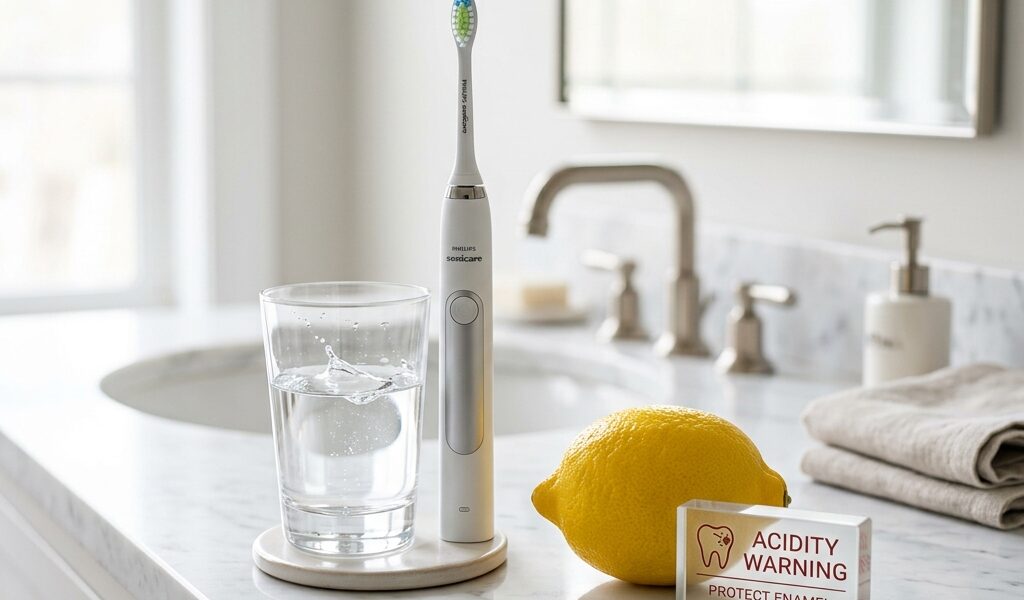
In the contemporary quest for a sparkling white smile and eco-friendly personal care methods, grandmother’s remedies and Do It Yourself (DIY) solutions have gained significant popularity. Among these, using lemon peel to whiten teeth is regularly promoted as a miracle solution on social media networks and zero-waste blogs. The pitch is undeniably appealing: it is an entirely natural, biodegradable, cost-effective, and easily accessible product. However, this seemingly harmless beauty hack hides a worrying biochemical reality. Far from being a gentle method to brighten enamel, the direct application of citrus peel onto dental surfaces is a chemically corrosive aggression of extreme severity for the dentition. This gesture, repeated in the name of natural beauty, triggers irreversible demineralization processes that permanently alter the very structure of the teeth. This article aims to analyze in detail, under a rigorous scientific prism, why using lemon peel for tooth whitening constitutes a genuine hazard to oral health, by breaking down the chemical erosion mechanisms at work.
Quick Answer
Whitening teeth with lemon peel is an extremely dangerous beauty hack that destroys dental enamel irreversibly. Although rubbing the peel may give the temporary illusion of whiter teeth by stripping away superficial stains and dehydrating the tooth, the extreme acidity of the lemon (pH between 2 and 3) triggers immediate demineralization of the enamel as soon as the pH drops below the critical threshold of 5.5. Additionally, citric acid acts as a powerful chelating agent that binds calcium ions, accelerating the dissolution of the mineral structure. Enamel is a non-vital tissue that cannot regenerate; therefore, it thins out over time, exposing the underlying dentin which is naturally yellow and porous. This chemical erosion leads to chronic pain, severe thermal and osmotic hypersensitivity, and a significantly increased risk of tooth decay, ultimately ruining both the aesthetics and health of the smile in the long term.
Scientific Explanation
To fully comprehend the danger that lemon peel poses to the oral cavity, it is necessary to analyze the physicochemical interaction between the components of the citrus fruit and the crystalline architecture of the tooth. Dental enamel is the most highly mineralized tissue in the human body, composed of approximately 96% mineral phase, with the remainder consisting of water and an organic protein matrix. This mineral phase is structured primarily as calcium hydroxyapatite crystals, whose stoichiometric formula is written as Ca10(PO4)6(OH)2. These crystals are organized into highly ordered prisms, giving the enamel its exceptional hardness. Under normal physiological conditions in the oral cavity, hydroxyapatite exists in a permanent dynamic equilibrium with saliva, which is supersaturated with calcium (Ca2+) and phosphate (PO43- or HPO42-) ions. Saliva acts as an essential buffering agent, maintaining a neutral oral pH that generally fluctuates between 6.7 and 7.3.
However, this thermodynamic equilibrium is governed by the solubility product of hydroxyapatite, which is extremely sensitive to variations in proton (H+) concentration. The critical pH threshold at which the salivary solution becomes undersaturated with respect to hydroxyapatite, initiating mineral dissolution, is historically established at 5.5. Below this limit, excess hydronium ions react with the phosphate and hydroxyl groups of the crystalline lattice according to the following simplified chemical equation:
Ca10(PO4)6(OH)2 (s) + 8 H+ (aq) → 10 Ca2+ (aq) + 6 HPO42- (aq) + 2 H2O (l)
Lemon peel, and more specifically the flavedo (the outer yellow layer containing essential oil glands) and the albedo (the inner white spongy layer), is saturated with residual lemon juice and essential oils rich in acidic compounds. The predominant acid is citric acid (2-hydroxypropane-1,2,3-tricarboxylic acid, C6H8O7), a weak tricarboxylic acid with three successive acid dissociation constants (pKa1 = 3.13, pKa2 = 4.76, and pKa3 = 6.40). The pH of lemon juice typically ranges from 2.0 to 3.0. Direct application of the peel releases these protons in high concentrations onto the dental surface, instantly dropping the oral micro-environment well below the critical threshold of 5.5.
Beyond simple proton release, citric acid poses a compounded hazard compared to other acids like phosphoric or hydrochloric acid at an equivalent pH. Indeed, the citrate ion (C6H5O73-) is an exceptionally efficient bidentate and tridentate chelating agent. It has a very high chemical affinity for divalent cations, particularly calcium (Ca2+). Through a complexation process, the citrate binds to the calcium ions within the hydroxyapatite lattice to form a stable soluble calcium-citrate complex, according to the reaction:
Ca2+ (aq) + Citrate3- (aq) → [Ca(Citrate)]- (aq)
This chelation shifts the chemical equilibrium of enamel dissolution by continuously removing free calcium ions from the reaction medium. Thus, even if the buffering capacity of saliva attempts to raise the pH, the presence of citric acid continues to strip calcium from the enamel via complexation. This double mechanism of direct acid attack and calcium chelation exponentially accelerates the kinetics of demineralization.
A critical aspect of this degradation lies in the biological inability of enamel to regenerate. Enamel is an acellular and non-vascularized tissue. The cells responsible for its formation during odontogenesis, the ameloblasts, undergo programmed cell death (apoptosis) once the tooth crown is fully formed and prior to its eruption into the oral cavity. Consequently, any loss of enamel resulting from chemical erosion is permanent and irreversible. The thinning of the enamel layer (which averages only 1 to 2 millimeters in thickness) leads inexorably to the exposure of the underlying dentin.
Dentin is a less mineralized tissue (about 70% hydroxyapatite), highly porous, and traversed by thousands of microscopic channels called dentinal tubules. These tubules contain the cytoplasmic processes of odontoblasts (Tomes’ fibers) and are in direct communication with the dental pulp, which houses sensitive nerve endings. When the protective enamel shield is lost, thermal (cold, hot), chemical (acids, sugars), and osmotic stimuli trigger hydrodynamic movements of the fluid within the dentinal tubules. These physical movements activate mechanoreceptors in the pulp, triggering the sharp, sudden pain characteristic of dentinal hypersensitivity (or hyperesthesia). Furthermore, dentin has an intrinsic yellow-orange coloration; its exposure by transparency through thinned enamel ironically gives the teeth a noticeably yellow and dull appearance, the exact opposite of the desired cosmetic outcome.
Hands-on Experience
To concretely illustrate the damage caused by this wild whitening method, I would like to share my own hands-on experience. Lured by the promises of several videos on content-sharing platforms promoting a simple, cost-free, zero-waste formula using organic squeezed lemon peels, I decided to give it a try. The recommended protocol seemed harmless: rub the inner side of the lemon peel (the white part or albedo, supposedly rich in active principles and enzymes) against the upper and lower incisors and canines for about three minutes, every night after brushing, over a two-week period.
For the first three days, the results seemed encouraging, albeit artificial. My teeth appeared to have a lighter shade, almost matte and chalky. I later learned that this effect was the result of temporary enamel dehydration and surface demineralization that altered light reflection, mimicking whitening. However, by the sixth day, the situation took a turn for the worse. A diffuse sensitivity began to set in, first when consuming cold drinks, and then on a permanent basis. By the end of the first week, drinking a simple glass of room-temperature water or eating hot soup triggered an unbearable electric shock of pain through all my front teeth.
Alarmed by this rapid deterioration, I stopped the treatment and consulted my dentist. The clinical examination under optical magnification revealed a microscopic disaster. The enamel of my incisors showed advanced areas of erosion, characterized by a loss of the original micro-prism surface texture and an abnormal polished-shiny appearance, typical of acid wear. The incisal edges had thinned, becoming translucent and brittle. The practitioner explained that I had literally dissolved the protective outer layer of my teeth. The consequences were severe: chronic dentin sensitivity that required in-office application of a fluorinated remineralizing varnish and the exclusive use of a desensitizing toothpaste containing potassium nitrate and arginine for several months to reseal the exposed tubules. The irony is that my teeth are now yellower than they were before the experiment, as the underlying dentin is now permanently visible through the thinned enamel.
Conclusion
In conclusion, using lemon peel to whiten teeth is a scientific aberration and a genuine cosmetic danger that must be avoided. Under the guise of a natural and zero-waste approach, this practice applies an aggressive acidic and chelating treatment to a non-renewable mineral tissue. The aesthetic and medical consequences – enamel erosion, paradoxical yellowing by dentin transparency, chronic pain, and hypersensitivity – far outweigh any short-lived and deceptive whitening effect. To preserve oral health, it is essential to prioritize scientifically validated methods under professional supervision and to remember that ‘natural’ is by no means synonymous with ‘safe’.