Comment faire sécher ses zestes de citron au four ou à l’air libre ?
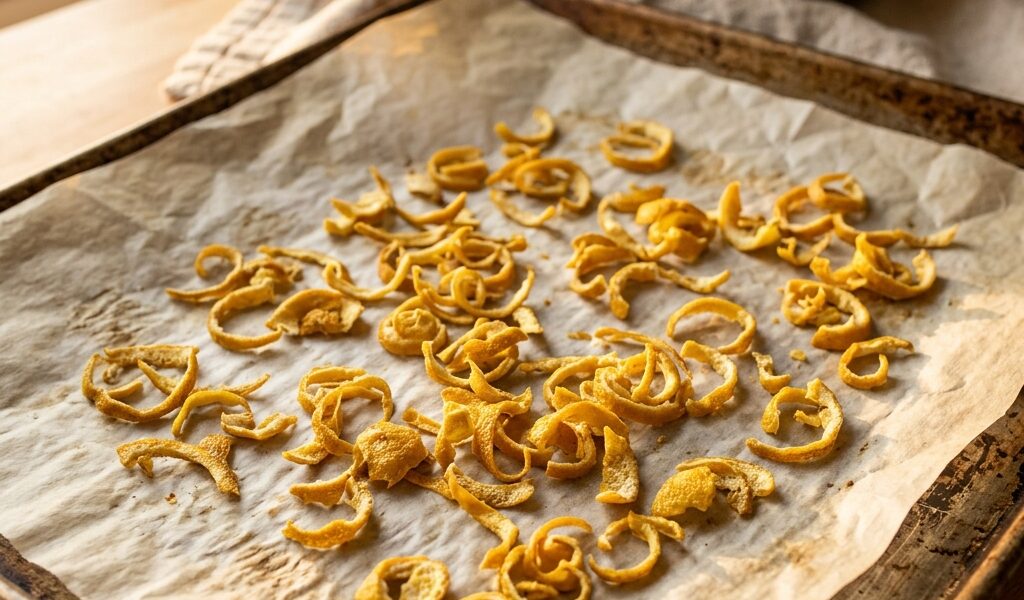
Drying lemon zest is an age-old preservation technique that transforms a fresh and ephemeral ingredient into a stable, concentrated, long-lasting powdered condiment. Well-dried zest can keep for several months in an airtight jar and can be used in place of fresh zest in the vast majority of culinary preparations. Mastering the drying of zest means mastering the art of aromatic concentration.
Two main drying methods are available: low-temperature oven drying, which is faster and more controlled, and air-drying, which is slower but better preserves the most volatile aromatic compounds. The choice between these two methods depends on your time constraints, the desired aromatic level in the final product, and the climatic conditions of your environment.
Quick Answer
To dry lemon zest in the oven: spread it in a thin layer on a parchment-lined baking sheet and bake at 50-60°C (fan-assisted) for 1.5 to 2 hours, slightly opening the oven door to allow moisture to escape. For air-drying: spread the zest on a fine sieve or wire rack, place in a dry, well-ventilated spot away from direct light, and leave to dry for 24 to 48 hours depending on ambient humidity. In both cases, the zest is ready when it snaps under your fingers.
Scientific Explanation
Drying is a dehydration process that aims to reduce the water content of lemon zest from its initial level (approximately 80-85% water by mass) to below 10%, a threshold below which the water activity (Aw) is low enough to inhibit microbial growth and enzymatic degradation reactions. Water activity (Aw) is the key parameter for the preservation of dehydrated foods: an Aw below 0.6 practically inhibits all pathogenic and spoilage microorganisms.
From a physicochemical perspective, low-temperature oven drying works through forced convection (fan-assisted heat) which accelerates the mass transfer of water from inside the cells to the surface of the zest, then into the ambient air by evaporation. The temperature of 50-60°C is a critical compromise: high enough to ensure efficient dehydration in a reasonable time, low enough to limit the thermal degradation of volatile aromatic compounds. Terpenes (D-limonene, beta-pinene) are thermolabile: above 70-80°C, their evaporation rate increases exponentially and a significant fraction of the essential oils is lost into the oven air. The partial opening of the oven door is essential to prevent saturation of the air around the zest with water vapor, which would slow moisture transfer by concentration gradient.
Air-drying, on the other hand, occurs at room temperature (20-25°C) through slow evaporation of water and diffusion of water molecules through the boundary layer of air in contact with the zest. This process better preserves the most volatile compounds as the low temperature limits their vapor pressure and therefore their evaporation into the atmosphere. However, prolonged exposure to atmospheric oxygen can initiate terpene oxidation reactions if drying is done in direct light (UV radiation catalyzes the oxidation of limonene).
After drying, the zest can be ground into powder using a spice grinder or blender to create a fine powder condiment, whose culinary use differs from dried zest pieces. The powder releases its aromas more quickly due to its higher specific surface area.
Hands-on Experience
I compared the aromatic profile of oven-dried zest (55°C, 2h) with air-dried zest (24h, 22°C, darkness) obtained from the same batch of organic lemons. The differences are subtle but real: oven-dried zest has a slightly softer aroma, with a slightly caramelized note due to partial Maillard reaction on the cell surface at 55°C. Air-dried zest retains a fresher, more floral note, closer to fresh zest, but requires greater vigilance against ambient humidity.
For pastry use, I prefer oven drying as it produces more homogeneous and stable zest. For use in teas or cold seasonings, air-drying is superior. An important tip: regardless of the method chosen, it is essential to use only organic, post-harvest untreated lemons, as drying concentrates all pesticide and wax residues present in the peel.
Conclusion
Drying lemon zest is a simple, economical and aromatically rewarding technique. The low-temperature oven offers speed and control, while air-drying better preserves fresh and volatile notes. In both cases, properly dried zest constitutes a quality powdered condiment that can advantageously replace fresh zest in most applications and keep for several months without significant aromatic loss.