How to Make Lemon Zest Without a Zester or Specific Grater?
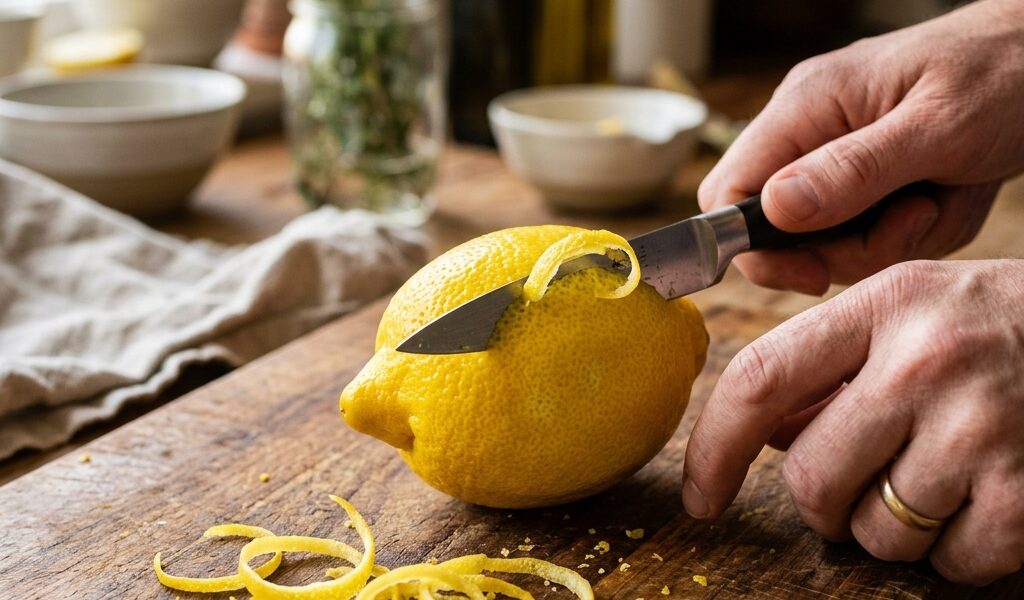
You are about to make a recipe that calls for lemon zest, but your zester has disappeared, you have no fine grater, and your kitchen lacks any specialized tool? Good news: there are several perfectly effective alternative methods for extracting lemon zest using everyday utensils. Culinary ingenuity does not require professional equipment to produce quality results.
Zest is the outer colored part of the lemon peel, rich in aromatic essential oils. The goal of any zesting technique is to remove only this thin golden layer without touching the underlying white part (the albedo), which is responsible for an unpleasant bitterness. This technical constraint applies regardless of the method used, whether conventional or improvised.
In this article, we will explore four of the best alternatives to a traditional zester: the vegetable peeler, the paring knife, the multi-purpose box grater, and the filleting knife. Each produces a different type of zest, suited to specific culinary uses.
Quick Answer
Without a zester or specific grater, you can make quality lemon zest using: a vegetable peeler (for thin ribbons), a paring knife (for julienne strips), the fine side of a multi-purpose box grater (for grated zest), or the technique of a fine-mesh strainer or stainless steel sieve. The key is to remove only the outer yellow layer while carefully avoiding the bitter white pith.
Scientific Explanation
Regardless of the technique used, the chemical objective remains the same: to extract the volatile compounds from the flavedo through mechanical rupture of the secretory pockets. These pockets, called schizogenous cavities, contain the hydrophobic terpenes of the lemon essential oil (D-limonene, citral, beta-pinene) under slightly higher-than-atmospheric pressure. Mechanical rupture releases these volatile aromatic molecules. The aromatic quality of the resulting zest therefore depends directly on the surface area of contact and the depth of the cut.
The peeler technique produces wide, relatively thick ribbons (1 to 2 mm) that contain a higher proportion of albedo than grated zest. This type of zest is ideal for infusions, jams, and decorations after blanching. The paring knife allows for more precise julienne cuts (strips about 1 to 2 mm wide and 5 cm long), used for high-end decorations and candied zest. The box grater (fine side) produces a result similar to a Microplane, with very fine particles of flavedo that quickly release their aromas in contact with fat and sugar, ideal for cake batters and emulsified sauces.
From a physicochemical perspective, fine (grated) zest has a much larger specific surface area than ribbons or julienne strips. This larger surface promotes the diffusion of volatile compounds into the food matrix, hence their preferred use in cake batters where aromas need to be evenly distributed.
Hands-on Experience
During an improvised cooking class without specialized equipment, I tested the vegetable peeler method combined with a paring knife to make a lemon meringue tart. I used the peeler to take large ribbons of zest, then the knife to finely dice them. The aromatic result was excellent, albeit slightly more rustic than the usual Microplane zest.
The most effective method without a specialized tool remains the fine-hole side of a box grater (the side with small round holes, not long slits). It produces a very fine, almost powdered zest that incorporates perfectly into batter. The key is to keep the lemon firm and rub with long, controlled strokes. To avoid albedo pieces, rotate the lemon regularly and stop as soon as the yellow surface turns white. I also tested a fine-mesh stainless steel strainer: by gently rubbing the lemon against the metal, you get a very fine and delicate zest, perfect for desserts. Less efficient in quantity, but remarkable in fineness.
For recipes requiring large volumes of zest, the peeler combined with the knife is the most productive solution. On the other hand, for applications requiring an intense aroma quickly released, the fine grater remains superior.
Conclusion
The absence of a zester or specific grater is not an insurmountable obstacle for making quality lemon zest. Whether you use a vegetable peeler, a paring knife, or the fine side of a box grater, the principle remains the same: remove only the outer colored layer of the lemon with light pressure and controlled movements. With a little practice, these alternative methods yield results fully comparable to those of professional tools.