How to Naturally Scent Your Home by Boiling Lemon Zest?
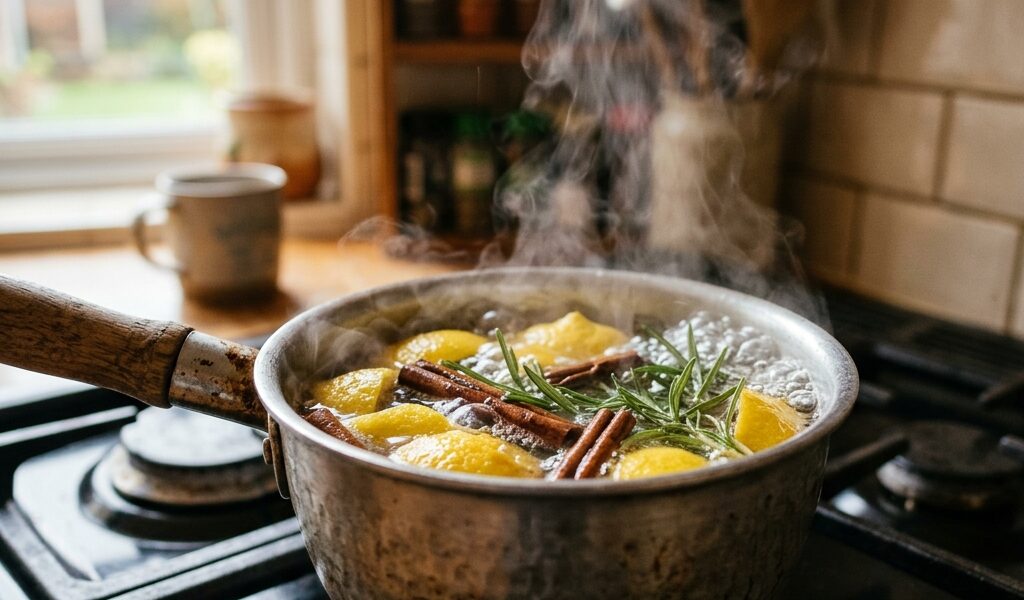
Indoor air quality has become a major public health concern. Commercial air fresheners, scented candles, and aerosol sprays are now identified as significant sources of domestic pollution, emitting toxic volatile organic compounds (VOCs) such as formaldehyde, benzene, and phthalates. To safely scent and purify one’s home, diffusion by hydrodistillation of natural ingredients represents a highly elegant alternative. Boiling organic lemon zest allows for the release of active aromatic molecules without combustion or synthetic solvents. This article analyzes the thermodynamic phenomena of this vaporization method and details its physical and sensory benefits.
Quick Answer
Boiling lemon zest in water naturally scents your home through a process of domestic hydrodistillation. The heat of the boiling water ruptures the aromatic glands of the peel (the flavedo), releasing volatile essential oils (such as d-limonene and citral) which evaporate alongside the water vapor. This method purifies the ambient air thanks to the antibacterial properties of terpenes, pleasantly humidifies the atmosphere, and eliminates stubborn cooking odors without releasing toxic synthetic pollutants.
Scientific Explanation
The olfactory diffusion achieved by boiling lemon peels is governed by the principles of the thermodynamics of heterogeneous binary mixtures and steam distillation (hydrodistillation). The aromatic compounds contained in the secretory pockets of the lemon’s flavedo are essentially hydrophobic lipophilic molecules. Lemon essential oil is primarily composed of monoterpene hydrocarbons (d-limonene ~65-75%, β-pinene ~10-15%, γ-terpinene ~8-12%) and oxygenated monoterpenes (citral under its two isomeric forms, geranial and neral, ~3-5%).
These molecules possess high boiling points under normal atmospheric pressure (176°C for d-limonene, 228°C for citral), far exceeding the boiling point of water. However, when the peels are submerged in boiling water (100°C), these compounds evaporate in large quantities. This phenomenon is explained by Dalton’s law of partial pressures. Water and hydrophobic terpenes form a non-miscible heterogeneous system. According to thermodynamics, the total vapor pressure (P_total) above the mixture is equal to the sum of the saturated vapor pressures of each pure constituent at the given temperature:
P_total = P_water + P_terpenes
Therefore, the mixture begins to boil at a temperature below the boiling point of the most volatile constituent (which is water, slightly under 100°C). The co-distillation vapor generated carries an azeotropic mixture of water vapor and volatile organic compounds (VOCs) of terpenic origin. Upon diffusion into the room’s atmosphere, this vapor condenses into suspended micro-droplets (natural aerosols), releasing the fresh, characteristic scent of lemon.
Furthermore, the diffused volatile terpenes possess aerial antiseptic properties. D-limonene and citral act by direct contact with the lipid membranes of airborne bacteria and fungal spores, disrupting their structural integrity and limiting their proliferation. This vaporization process also increases the relative humidity of the indoor air, which promotes the physical precipitation of suspended dust particles through coalescence.
Hands-on Experience
I tested the efficacy and persistence of this natural scenting method in a 35 m² living area after preparing a meal that left strong, stubborn frying odors (hot fats release volatile acrolein, which is highly persistent). The protocol involved using the zest of three organic lemons combined with aromatic herbs to create an olfactory synergy.
In a stainless steel pan containing one liter of filtered water, I added the lemon zest, two sprigs of fresh rosemary (rich in cineole and camphor), and one teaspoon of natural vanilla extract (containing vanillin). The mixture was brought to a boil, then maintained at a gentle simmer (around 90°C-95°C) on an induction cooktop set to low power for 45 minutes.
The deodorizing effect was noticeable within the first ten minutes of simmering. The frying odor was completely neutralized, not by simple olfactory masking, but through a combination of hygrometric saturation (which precipitates odor particles) and the volatile acidity of citral interacting with suspended basic compounds. The room was filled with a fresh, energizing, and comforting fragrance. The scent remained pleasant for about six hours after turning off the heat. Furthermore, none of the classic side effects of chemical fragrances (headaches, eye irritation) were experienced, validating the safety of this method.
Conclusion
Boiling lemon zest is far more than a simple grandmother’s trick: it is an elegant household application of chemical thermodynamics. By exploiting steam distillation to diffuse purifying monoterpenes, this method provides a healthy, economical, and highly effective scenting solution. It reconciles olfactory comfort, humidity regulation, and respiratory health preservation, establishing itself as a fundamental practice for purifying the air of a zero-waste home.