Marinades pour poissons et volailles : l’apport aromatique unique du zeste râpé
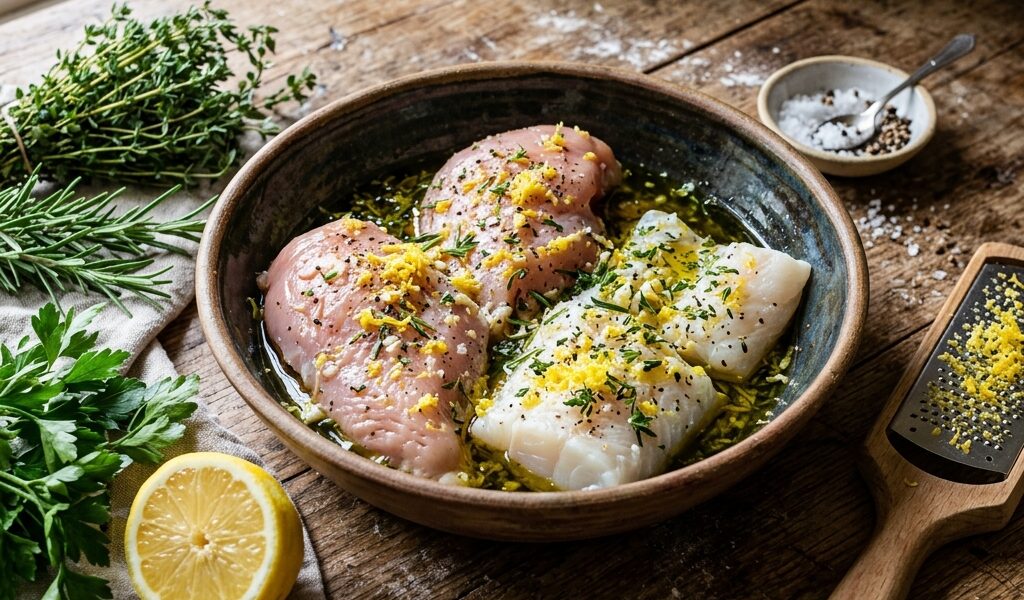
Marinating is an ancient culinary technique based on the ability of acids, fats, and aromatic compounds to modify the texture and flavor profile of animal proteins before cooking. Among all usable aromatic ingredients, grated lemon zest holds a singular place: it brings an olfactory and gustatory dimension that neither lemon juice, dried spices, nor fresh herbs can reproduce alone. Its unique terpenic profile makes it a remarkably effective natural flavor enhancer for fish and poultry.
The difference between a marinade containing lemon juice and one with grated zest is far deeper than a simple question of acidity. Juice mainly provides citric acid (tenderizing and acidifying effect), while zest provides the essential oils of the flavedo, a cocktail of fat-soluble terpenes and aldehydes that incorporate into the muscular fats of the meat or fish and persist through cooking. It is this aromatic persistence at high temperature that makes zest marinade a superior technique for grilled meats and oven-baked fish.
Quick Answer
Grated lemon zest uniquely enriches marinades because its essential oils (D-limonene, citral) are fat-soluble and dissolve in the olive oil of the marinade, thereby penetrating deeply into the muscle fibers of fish or poultry. Unlike juice (acidic and volatile at heat), zest imparts an aroma that withstands cooking and elevates the final taste of the dish. For an effective marinade: 1 teaspoon of organic grated zest per 2 tablespoons of olive oil, marinate for a minimum of 30 minutes and a maximum of 2 hours in the refrigerator.
Scientific Explanation
The mechanism of aromatic penetration from zest into the muscle tissue of poultry and fish involves lipid diffusion and solute partitioning phenomena. The essential oils of the flavedo (primarily monoterpene hydrocarbons and terpene aldehydes) are highly hydrophobic molecules (log P between 3 and 5). In an oil-lemon juice marinade, these compounds preferentially dissolve in the fat phase (olive oil), forming a continuous aromatic phase. When fish or poultry is immersed in this marinade, the aromatic fat phase comes into contact with the cell membranes of the muscle fibers. Through a thermodynamic partitioning mechanism (lipid-lipid partition equilibrium), terpenic compounds migrate from the fat phase of the marinade into the membrane phospholipids of the muscle cells, which act as absorption reservoirs.
This lipid incorporation is fundamentally different from the absorption of citric acid from juice, which is a water-soluble compound and does not penetrate lipid membranes with the same efficiency. Marinating time is a critical factor: 30 minutes allows surface impregnation, 2 hours allow deeper diffusion into the muscle layers. Beyond 4 to 6 hours for fish (more fragile tissue), the citric acid from juice can induce excessive protein denaturation (ceviche effect: cold acid cooking), altering the final texture.
During cooking, the Maillard reaction between the amino acids of denatured proteins and the reducing sugars of the marinade creates browning compounds that fix and amplify the terpenic aromas of the zest, creating a complex aromatic crust not achieved with juice alone. D-limonene, while partially volatilized at high temperatures, leaves through oxidation secondary compounds (carvone, p-cymene) that positively contribute to the final aromatic profile of the cooked meat.
Hands-on Experience
In professional cooking, I systematically substituted lemon juice with grated zest in marinades for sea bass fillets, sea bream, and chicken supremes. My base marinade includes: the grated zest of one organic lemon, 4 tablespoons of extra virgin olive oil, one minced garlic clove, fresh thyme, salt and pepper. No juice. The flesh is marinated for 1 hour in the refrigerator, then baked at 200°C or grilled on a plancha.
The result is spectacularly different from a juice marinade: the flesh shows no acid-cooked surface effect (avoiding the drying that juice can cause), the lemon note is deep and persistent after cooking, and the overall aroma of the dish is more complex and elegant. This technique is particularly effective for oven-roasted poultry, where zest rubbed under the chicken skin before cooking diffuses its essential oils directly into the subcutaneous fat, creating an intense scent that permeates the entire flesh during cooking.
Conclusion
Incorporating grated lemon zest into marinades for fish and poultry is a professional technique that exploits the fat-solubility of flavedo essential oils to create a deep aroma that persists through cooking, far superior to lemon juice. This scientifically grounded approach transforms a simple marinade into a sophisticated aromatic preparation, accessible to all cooks who take the time to understand the chemistry of their ingredients.