How to Replace Lemon Zest in a Baking Recipe: The Ultimate Alternatives
Lemon zest is a fundamental ingredient in baking. Obtained by grating the superficial layer of the citrus peel, known as the flavedo, it provides incomparable freshness, intense aromatic vivacity, and a characteristic scent without adding the acidity or moisture of the juice. However, it is common to find oneself without fresh lemons when making a recipe, or lacking organic, untreated fruits whose skin is free of pesticides and chemical preservatives. In these situations, it is crucial to know how to replace this ingredient without altering the texture, physicochemical balance, and aromatic profile of your sweet creations.
Substituting lemon zest is not as simple as pouring a bit of juice into your cake batter. It requires an understanding of how aromas are structured and how they react to baking. Zest provides lipophilic essential oils that integrate perfectly with the fats in the recipe (such as butter or oil), whereas juice provides hydrophilic citric acid that can modify the pH of the mixture and disrupt the action of leavening agents. Thus, the choice of substitute will heavily depend on the role played by the zest in the original recipe: a simple background flavor note, a taste enhancer, or the star of the dessert.
Quick answer
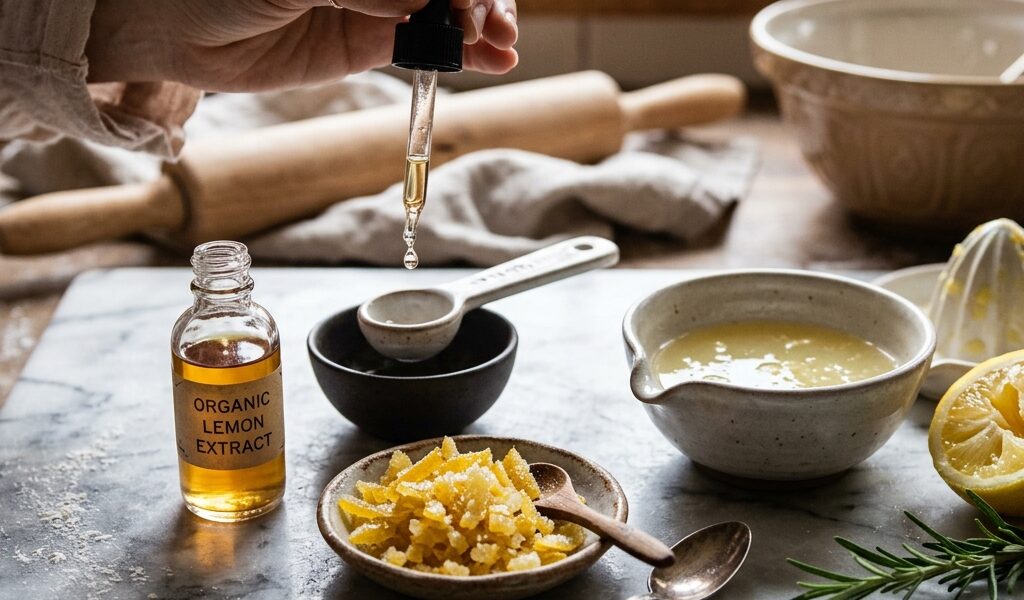
To replace lemon zest in a baking recipe, the best alternative depends on the desired effect: use natural lemon extract (1/2 teaspoon for the zest of one lemon) for a pure and concentrated flavor, or the zest of other citrus fruits (lime, orange, grapefruit) in equal proportions to maintain texture. For an original twist, finely chopped or infused lemongrass brings elegant herbal and lemony notes. As a last resort, lemon essential oil (2 to 3 drops diluted in a fat) or dried zest powder (1/2 teaspoon) will work perfectly. Avoid replacing zest with lemon juice in large quantities, as the acidity and excess liquid risk disrupting the chemistry of your batter.
Natural lemon extract remains the most faithful substitute in terms of pure aromatic profile. Derived from macerating lemon peels in alcohol, it contains the same volatile compounds as fresh zest. However, it lacks the physical texture of the zest, which sometimes plays an aesthetic or structural role in cookies or travel cakes. Other citrus fruits, on the other hand, offer an identical physical replacement while introducing interesting aromatic variations. Lime will yield a sharper, more exotic profile, while orange will bring roundness and sweetness.
The Scientific Explanation
From a biochemical and thermodynamic perspective, the flavedo of the lemon is a plant tissue rich in secretory glands containing essential oils. These oils are composed of more than 90% molecules from the terpene family. The major constituent is d-limonene (approximately 60 to 75%), a cyclic monoterpene that is hydrophobic and brings a fresh, slightly fruity note. However, the typical olfactory signature of lemon comes from minor but extremely powerful molecules: citral (a mixture of two geometric isomers, geranial and neral) and g-terpinene. Citral has an extremely low odor detection threshold, meaning that even in tiny amounts, it dominates sensory perception.
When substituting zest with lemon juice, the physicochemical system of the batter is radically altered. The juice is an acidic aqueous solution, rich in citric acid (pH around 2.2). Introducing a strong acid into a cake batter has several major consequences. On one hand, acidity modifies the electrical charge of gluten proteins (gliadins and glutenins), which weakens the gluten network and can make the cake more crumbly or rise less. On the other hand, if the recipe contains sodium bicarbonate (baking soda), the citric acid reacts immediately to release carbon dioxide (CO2), causing premature rising before the cake structure is set by the heat of the oven. Additionally, the aromatic compounds of lemon juice are not the same as those of the zest. Juice contains very few volatile terpenes, and its water-soluble compounds undergo rapid thermal degradation above 100°C, losing their aromatic value in favor of a flat acidity.
The use of essential oils or alcoholic extracts poses another physical challenge: aroma retention during baking. d-Limonene has a boiling point of 176°C, but due to the steam generated in the cake during baking, a phenomenon of steam distillation (or hydrodistillation) occurs. Volatile aromatic molecules escape from the batter along with moisture. To limit this loss, it is essential to bind the substitute aromas to lipids. Terpenes, being highly hydrophobic, have a very high octanol/water partition coefficient. Simply put, they prefer to dissolve in fats. Mixing the extract or essential oil with the melted butter or oil of the recipe before incorporating the other ingredients helps trap these volatile molecules within the lipid matrix, limiting thermal evaporation and ensuring optimal aromatic persistence after baking.
Practical feedback
As part of our pastry laboratory tests, we carried out a comparative study on a classic madeleine recipe, known for its sensitivity to ingredient variations. We prepared five distinct batches by replacing the fresh lemon zest with different substitutes to evaluate the impact on taste, texture, and the development of the madeleine’s famous humped top.
The first batch was made by replacing the zest of one lemon with 15 ml of fresh lemon juice. The results were disappointing. The batter, which became too acidic and liquid, coagulated too quickly during baking. The final texture was dense, sticky, and wet, with an almost total loss of the characteristic hump. Taste-wise, the acidity masked the sweetness of the butter and the lemon aroma was virtually absent after baking.
The second batch integrated 1/2 teaspoon of high-quality natural lemon extract. Here, the structure of the madeleine was perfect, with a beautiful golden hump and an airy crumb. The lemon flavor was distinct, clean, and balanced, though slightly less complex than that provided by fresh zest. This is the simplest and most effective option for a professional result without altering the physical texture.
The third batch used fresh lemongrass. We infused two crushed lemongrass stalks in the hot butter of the recipe for 30 minutes, then strained the butter before making the batter. The result was a gastronomic revelation. The madeleines had a subtle, very fresh lemony note, accompanied by floral and slightly gingery nuances. This lipid infusion technique proved extremely effective in capturing thermosensitive aromas.
The fourth batch was prepared with organic lime zest. Visually, tiny green specks were visible in the crumb. Taste-wise, the madeleine offered a much more dynamic profile, with very bright and impactive top notes. The structure and texture of the madeleine were identical to the control batch (with yellow lemon zest). This proves that lime zest is an excellent direct alternative in a 1:1 ratio.
Conclusion
Replacing lemon zest in baking is entirely possible provided the physical and chemical laws of baking are respected. Natural lemon extract and the zest of other citrus fruits remain the safest and most faithful substitutes to maintain the integrity of your recipes. If you are looking for innovation, infusing lemongrass in fats offers a premium alternative that will pleasantly surprise your guests. In any case, avoid using lemon juice as an aromatic substitute, as it will ruin the texture and balance of your cakes.