Pâtes au citron et parmesan : le secret de la sauce réside dans l’infusion du zeste
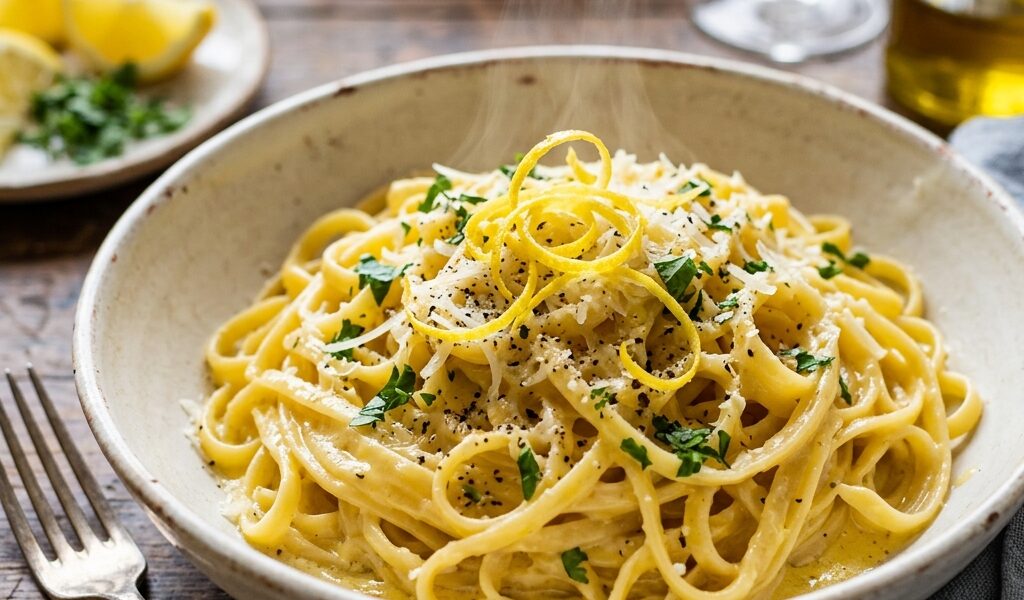
Lemon parmesan pasta is one of the simplest and most elegant dishes in contemporary Italian cuisine. Yet the difference between a mediocre version and one that leaves an unforgettable taste memory comes down to a single technical gesture: the preliminary infusion of lemon zest in the fat before emulsifying the sauce. This seemingly insignificant gesture is in reality a sophisticated application of flavor chemistry principles applied to gastronomy.
Most common lemon pasta recipes simply add lemon juice and grated zest directly to the cooked pasta. The result is adequate but lacks depth and complexity. The professional technique of infusing the zest in butter or cream, before incorporating any other ingredients, creates an aromatic base of a richness and gustatory persistence that is radically different. Here is why and how to master this technique.
Quick Answer
For exceptional lemon parmesan pasta, infuse the grated zest of one organic lemon in 50g of butter melted over very low heat (60-70°C) for 5 minutes, then remove from heat and allow to cool slightly. The fat-soluble essential oils from the zest dissolve into the butter, creating an intense aromatic base. Then build your sauce with this lemon butter, cream (if used), pasta cooking water, and grated parmesan off the heat. The result is a sauce of a richness and lemon intensity that fresh zest added alone cannot produce.
Scientific Explanation
The technique of infusing zest in a fat (butter, olive oil, cream) rests on the principle of lipophilic partitioning of terpenes. The essential oils of the flavedo (D-limonene, citral, beta-pinene) are hydrophobic molecules with high octanol/water partition coefficients (log P: 4.6 for limonene, 3.5 for citral). At moderate temperature (60-70°C), their solubility in the fat phase is maximized and their diffusion kinetics from the secretory cells of the zest into the fat are accelerated. Unlike cold infusion (slow but better preserving the most volatile notes), infusion at 60-70°C offers an optimal balance between extraction speed and preservation of the most fragile aromatic compounds.
Butter is a complex natural emulsifier (composed of fat, water, and whey proteins) whose fat fraction constitutes the main solvent for essential oils. The whey proteins (beta-lactoglobulin, alpha-lactalbumin) also play a role as aromatic fixatives through non-covalent binding with certain terpenic compounds, slowing their volatilization and making them progressively available during tasting.
The addition of pasta cooking water (rich in gelatinized surface starch) to this lemon butter creates an oil-in-water emulsion stabilized by the amyloses and amylopectins released from the pasta. This emulsion perfectly coats the pasta with a continuous, smooth film. Parmesan, rich in free glutamic acid (umami) and calcium, contributes both to texture (emulsifying role of its heat-coagulated proteins) and to overall taste intensity through a umami-lemon synergy effect.
Hands-on Experience
I prepare this dish regularly and the technique of infusing the zest in butter has become essential in my routine. The precise procedure: I melt the butter over very low heat in the serving pan, add the grated zest and infuse for 5 minutes, stirring gently. The released essential oil is visible: fine iridescent droplets rise to the surface of the butter. I remove the pan from the heat, add 100ml of pasta cooking water, then build the emulsion by shaking vigorously. I incorporate the parmesan off the heat in a fine shower, then the pasta straight from the boiling water. A dash of fresh lemon juice at the very end, and the dish is served immediately.
The difference from the classic method (adding zest directly to the pasta) is particularly noticeable in terms of mouth persistence: with the butter infusion, the lemon aroma accompanies every bite to the last, whereas with direct fresh zest, the lemon note is strong on first contact and quickly fades. This is the difference between an aroma fixed in the fat matrix and a surface aroma that evaporates quickly.
Conclusion
The secret of the best lemon parmesan pasta lies in the preliminary infusion of the zest in the fat, a technique that exploits the fat-solubility of the flavedo’s essential oils to create a deep, homogeneous, and persistent aromatic base. This scientifically grounded approach transforms a simple dish into a gastronomic experience of remarkable aromatic complexity, accessible to all cooks who take the time to understand the chemistry of their ingredients.