Microplane Grater vs Traditional Zester: Which Tool for a Perfect Zest?
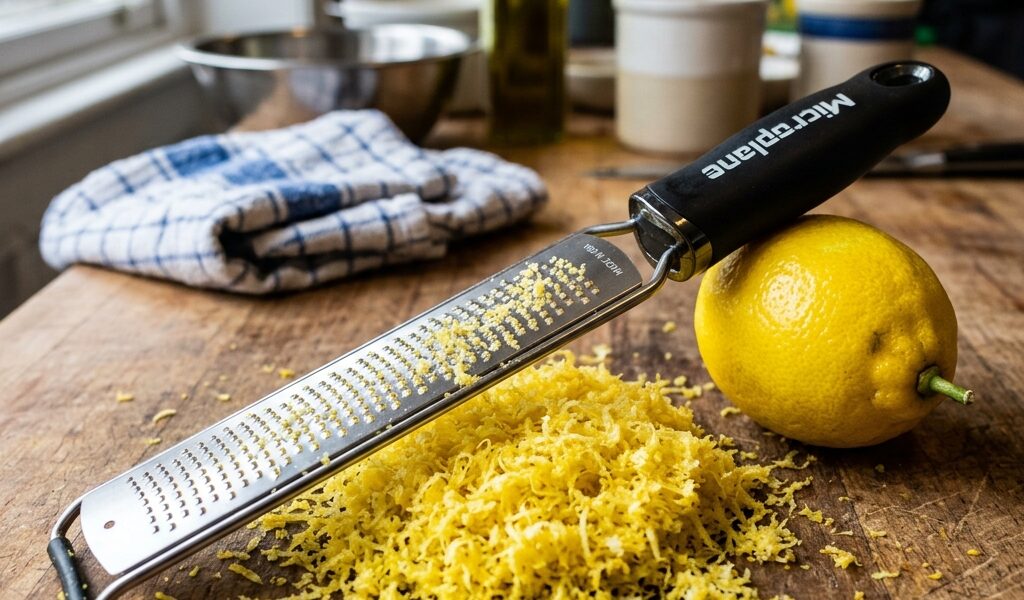
The kitchenware market offers two main families of tools for zesting citrus fruits: the Microplane grater, of American origin, and the traditional channel zester, a historical tool of classical gastronomy. These two instruments produce radically different types of zest in terms of size, texture, and aromatic behavior. Choosing between them is not a matter of personal preference but of understanding the physicochemical properties of the zest you are trying to obtain.
The Microplane grater revolutionized the world of professional cooking in the 1990s by enabling extremely fine, almost ethereal zest to be obtained in seconds. The traditional zester, on the other hand, produces long, regular strips that have specific advantages in certain culinary applications. Knowing the characteristics of each allows you to optimize your preparations according to the desired result.
Quick Answer
The Microplane grater is superior for obtaining fine, highly aromatic zest that is easy to incorporate into batters and sauces. The traditional channel zester is preferable for obtaining long, regular strips used in decoration and confectionery. For versatile daily use, the Microplane is the top choice of professionals. For decoration and confectionery preparations, the channel zester remains irreplaceable.
Scientific Explanation
The fundamental difference between the two tools lies in the morphology of their blades and the cellular surface they expose during harvesting. The Microplane grater is equipped with acid photo-etched blades (as opposed to traditional stamped graters), which create extremely sharp cutting edges with perfectly clean borders. These micro-blades slice the flavedo cells into fragments of 0.1 to 0.5 mm without crushing them. This clean sectioning maximizes the exposed cut surface, thereby releasing the maximum amount of volatile essential oils immediately available in the zest. The surface-to-volume ratio is optimal, resulting in superior aromatic intensity per equal volume.
The traditional zester, on the other hand, uses a blade punctuated with oval or round holes approximately 3 to 4 mm in diameter, bordered by a small cutting edge. This system cuts ribbons of flavedo of relatively significant cross-section (several millimeters thick), producing a less clean cut at the cellular level. Secretory cells are partially crushed rather than sectioned, which immediately releases essential oils but also creates slight mechanical pressure on adjacent albedo cells if the cut is too deep. The ribbons produced have a specific surface area far inferior to Microplane particles, meaning their aromatic diffusion into aqueous or fatty matrices is slower and often requires an infusion or maceration time.
In terms of particle size, Microplane particles have a distribution 10 to 50 times smaller than the strips from a traditional zester. This size difference has direct consequences for mouthfeel (less perceptible texture with the Microplane) and the rate of flavor release during cooking.
Hands-on Experience
In professional practice, I systematically use the Microplane for all preparations where zest must be incorporated into the bulk: cake batters, creams, mayonnaises, compound butters, vinaigrettes, and marinades. The fineness of the particles allows for homogeneous dispersion in the preparation without creating perceptible texture chunks. The aromas are immediately active upon incorporation.
The channel zester, I reserve for three specific uses: cocktail decoration (the ribbons are twisted over the edge of the glass), candied zest preparation (long ribbons are better suited to this treatment because they maintain their shape when cooked in syrup), and long-duration infusions in oils or spirits (the ribbons offer sufficient exchange surface for a gradual aromatic bath). I found, in a direct comparison, that for the same amount of zest, the Microplane delivered an aromatic punch approximately 3 to 4 times more intense on direct smell, which is explained by the much larger evaporation surface of the micro-particles.
Conclusion
The Microplane grater and the traditional zester are not in competition: they are complementary. The Microplane excels in all applications requiring fine incorporation and maximum aromatic intensity in the mass. The traditional zester remains the king of decoration, confectionery, and infusions. An ideal kitchen setup will include both. If you must choose only one, the Microplane is the best investment for versatile daily use.