Household Vinegar with Lemon Zest: The Ultimate Eco-Friendly Multi-Surface Cleaner
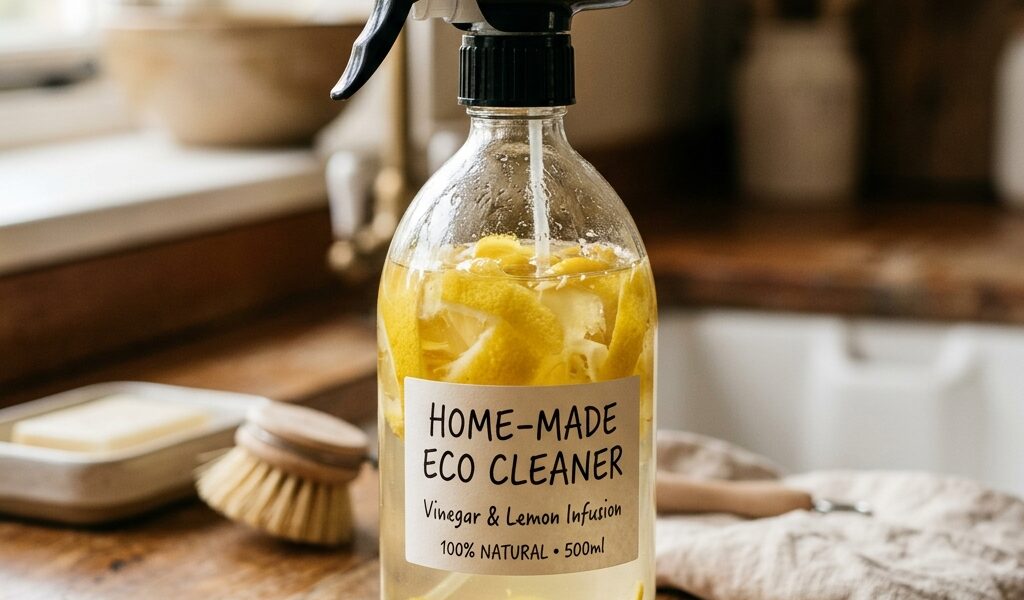
In the current context of ecological transition and the reduction of endocrine disruptors in the domestic environment, finding alternatives to synthetic detergents has become a priority. Among the most popular DIY (Do It Yourself) solutions, the combination of white vinegar and lemon zest stands out for its formidable effectiveness and simplicity of preparation. However, far from being a simple empirical recipe passed down through generations, this multi-surface cleaner is based on precise chemical and physical principles that make it a highly effective descaling and degreasing agent. This article aims to analyze the biochemical mechanisms that give this mixture its exceptional properties, while providing a rigorous manufacturing protocol.
Quick Answer
Household vinegar infused with lemon zest is the ultimate eco-friendly cleaner because it combines the acidic strength of vinegar (acetic acid) with the powerful solvent ability of d-limonene found in the citrus peel. Acetic acid efficiently dissolves limescale (calcium carbonate) and destroys bacterial cell membranes, while d-limonene solubilizes fats and oils. A two-week maceration period yields a concentrated, biodegradable, non-toxic, and pleasantly scented product, eliminating the need for industrial chemical cleaners.
Scientific Explanation
The biocidal and surfactant efficiency of lemon zest vinegar is explained by the physicochemical synergy between a hydrophilic carboxylic acid and a hydrophobic terpene. Commercial white vinegar is an aqueous solution of acetic acid (CH3COOH) whose concentration typically ranges from 8% to 14% (equivalent to a molarity of approximately 1.3 to 2.3 mol/L). This weak acid has a pH between 2.4 and 2.8. Its primary function lies in its ability to donate protons (H+) in solution. Upon contact with limescale, which consists of calcium carbonate (CaCO3), acetic acid reacts according to the following double displacement equation:
CaCO3 (s) + 2 CH3COOH (aq) → Ca(CH3COO)2 (aq) + CO2 (g) + H2O (l)
Calcium carbonate, which is insoluble in water, is converted into calcium acetate, a highly soluble salt, leading to the immediate dissolution of limescale deposits. Furthermore, the acidity of the vinegar alters the trans-membrane pH gradient of microorganisms, causing denaturation of their surface proteins and subsequent cell lysis.
However, acetic acid alone has limitations when facing lipophilic soils (fats, oils, waxes). This is where the maceration of lemon zest comes into play. The flavedo (the yellow outer layer of the peel) contains secretory pockets rich in essential oils, composed of more than 90% d-limonene (1-methyl-4-(prop-1-en-2-yl)cyclohexene), a monocyclic monoterpene. Acetic acid and water in vinegar act as a polar extraction solvent that ruptures these pockets through osmotic pressure and solubilizes the volatile compounds. D-limonene is an apolar hydrophobic molecule.
Under the chemical principle of “like dissolves like,” d-limonene penetrates the molecular structure of hydrophobic fats. It inserts itself between the fatty acid chains of the triglycerides that constitute grease stains, reducing their internal cohesion and facilitating their detachment from the surface. In addition, the residual presence of citral (geranial and neral) in the extract provides complementary antimicrobial properties by disrupting the permeability of the plasma membrane of Gram-positive and Gram-negative bacteria.
Hands-on Experience
In a comparative study conducted at home over a four-week period, I tested the effectiveness of this lemon-infused vinegar against pure white vinegar and a conventional multi-surface cleaner containing ethoxylated surfactants. The tests were performed on three types of surfaces: vitroceramic cooktops soiled with carbonized grease splatters, glass shower walls covered with stubborn limescale, and granite countertops.
The preparation protocol consisted of placing the zest of four organic lemons in a glass jar, covering them with one liter of 12% white vinegar for 14 days away from light, and then filtering the liquid using a micrometric paper filter. For application, the product was diluted to 50% with demineralized water in a spray bottle.
The results are clear: on carbonized grease, the lemon vinegar far outperforms pure white vinegar. The solvent action of d-limonene allows grease to be lifted in a single pass, without requiring abrasive scrubbing that could scratch the vitroceramic surface. On shower wall limescale, dissolution is instantaneous and identical to that of pure vinegar, but with a major advantage: the pungent, suffocating smell of acetic acid is neutralized by the zesty notes of limonene and citral, making the spray much more comfortable to use in confined spaces. The only precaution taken: this acidic cleaner must not be used on granite or marble, as acetic acid reacts with the calcium carbonate and silicates of these natural stones, risking dulling their polished surface finish.
Conclusion
Infusing lemon zest into white vinegar transcends the limitations of these two ingredients when used individually. By combining an acidic descaling agent and a powerful organic degreasing solvent, this simple formula provides an eco-friendly alternative of comparable, if not superior, efficacy to synthetic products. Its low cost, total biodegradability, and toxicological safety make it the essential cornerstone of a zero-waste household that respects both health and the environment.