How to Easily Clean Your Zest Grater Without Getting Hurt or Damaging the Blades?
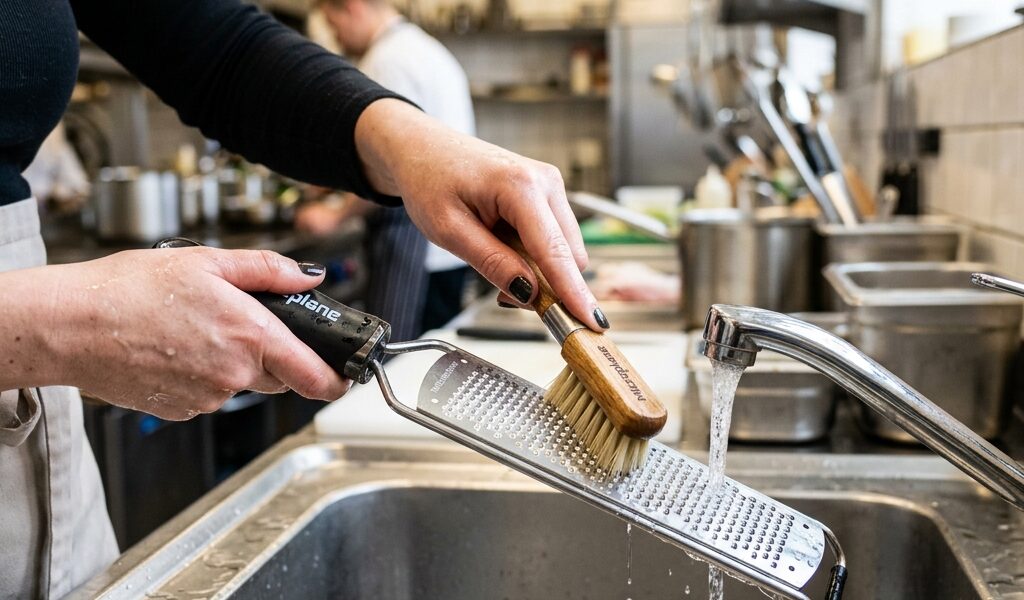
Among the indispensable tools of the modern kitchen, the fine rasp-style zest grater, such as a Microplane, holds a place of pride. Thanks to its manufacturing process involving chemical photo-etching, it produces lemon zest of incomparable fineness, free of any bitter white albedo. However, this tool has a well-known drawback for all its users: it is dangerous and difficult to clean. Hundreds of tiny, razor-sharp blades, oriented in a single direction, act as traps that stubbornly catch plant fibers and sticky pectins from the citrus fruit. Cleaning this tool with a conventional sponge often leads to the destruction of the sponge and painful cuts on your fingers. Conversely, using overly aggressive methods or relying too heavily on the dishwasher can prematurely dull the blades or promote metal corrosion. This article details the mechanisms of zest residue adhesion to metal, presents a physical analysis of cleaning, and proposes safe, quick methods to maintain your grater risk-free.
Quick Answer
To clean a zest grater easily and safely, the golden rule is to act immediately after use by running the grater under a stream of warm water from the opposite side of the blades (from back to front). This instantly flushes out the majority of fibers without damaging your tool or cutting your fingers. To remove stubborn dried pectin residues, gently scrub the grater in the direction opposite to the blades (from the handle toward the tip) using a stiff-bristled dish brush or an old toothbrush dipped in dish soap. Finally, the ultimate trick if residues have dried is to grate a piece of raw potato: the starch captures the fibers and cleans the crevices, making the final rinse incredibly simple. Avoid the dishwasher entirely, as it corrodes the micro-blade edges.
Scientific Explanation
The adhesion of lemon zest residues to the micro-blades of the grater is explained by the biochemical nature of the plant material and the tribology of the utensil. Grated zest is a mixture of cellular debris rich in cellulose (an insoluble glucose polymer), hemicellulose, and pectins. Pectins are branched acidic polysaccharides composed mainly of partially methylated galacturonic acids. In an acidic environment (the zest being impregnated with residual acidic lemon juice), the pectin chains form a three-dimensional network through hydrogen bonding and calcium cross-linking. As it dries, this hydrocolloid gel acts as a powerful adhesive, binding the cellulose fibers to the rough surface of the stainless steel.
From a physical standpoint, precision graters are made from martensitic stainless steel (typically AISI 301 or 410). This steel undergoes a photo-etching process (chemical machining) that creates extremely acute cutting angles and microscopic edge thicknesses (under 10 micrometers). When a conventional sponge or cloth is rubbed against these blades in the direction of the cut, the synthetic fibers of the sponge are sheared by the blades and accumulate beneath the cutting edges, increasing the obstruction.
Hot cleaning in a dishwasher is discouraged for metallurgical reasons. Dishwasher detergents contain strong alkaline agents (silicates, carbonates) and oxidizing bleaching agents that attack the chromium passive layer (Cr2O3) of the stainless steel. Furthermore, the presence of chloride ions in hot water promotes pitting and crevice corrosion under moist organic residues. Repeated exposure to high drying temperatures (around 70°C) in a moist acidic environment accelerates the electrochemical corrosion kinetics at the extremely thin cutting edge of the blade, causing rapid dulling through micrometric dissolution of the metal arris.
Using a stiff synthetic brush (such as nylon) allows for targeted mechanical force in the crevices without damaging the steel. The brushing motion must be executed parallel to or in the opposite direction of the blade edge to prevent shearing of the brush bristles. Dish soap (an anionic surfactant) reduces the surface tension of water, promoting hydration and solubilization of the gelled pectins by breaking hydrogen bonds.
Hands-on Experience
To compare the effectiveness and safety of different cleaning methods, I intentionally soiled five identical Microplane graters by grating the peel of two lemons on each, then letting the residues dry in the open air for two hours to simulate a worst-case scenario (completely dry, hard pectins). I then tested the following protocols:
- Protocol A: Cleaning with a conventional sponge (green abrasive side) under warm water.
- Protocol B: Immediate rinsing with cold water against the direction of the blades, with no tool.
- Protocol C: Washing in the dishwasher (standard 65°C cycle with an all-in-one detergent tablet).
- Protocol D: Soaking for 10 minutes in warm soapy water followed by brushing with a toothbrush.
- Protocol E: Grating half a raw potato on the soiled grater, followed by a simple water rinse.
Protocol A was a complete failure: the sponge was shredded by the micro-blades, leaving green synthetic fiber residues trapped under the blades that were even harder to remove. Additionally, I suffered a minor cut on my thumb. Protocol B worked partially but failed to remove the dried zest pieces that had been stuck for two hours. Protocol C (dishwasher) cleaned the grater satisfactorily to the eye, but after 15 cycles, I noticed a significant loss of the grater’s sharpness during a comparative test on tomato skin, confirming dulling by corrosion.
Protocol D was highly effective and safe. The soaking re-hydrated and swelled the pectins, and brushing with a toothbrush in the opposite direction of the blades removed 100% of the residues in less than a minute, without any injury.
However, Protocol E (the potato trick) proved to be exceptionally clever. By grating the raw potato, the released moisture and starch acted as a gentle mechanical cleaning agent. The potato pieces pushed the zest debris out and away from the blades. After a simple rinse under the tap, the grater was perfectly clean in less than 15 seconds, requiring no tedious manual scrubbing. This is the ideal method for cleaning a grater when you don’t have time to deal with it immediately.
Conclusion
Cleaning a fine zest grater no longer needs to be a dreaded chore. By avoiding the dishwasher to preserve the sharpness of the steel and adopting the habit of immediate rinsing from the back, you will extend the life of your utensil. For dried residues, gentle brushing with a toothbrush or the potato trick will allow you to restore a pristine grater in complete safety.