Nettoyer son micro-ondes incrusté en 3 minutes avec de l’eau et des zestes de citron
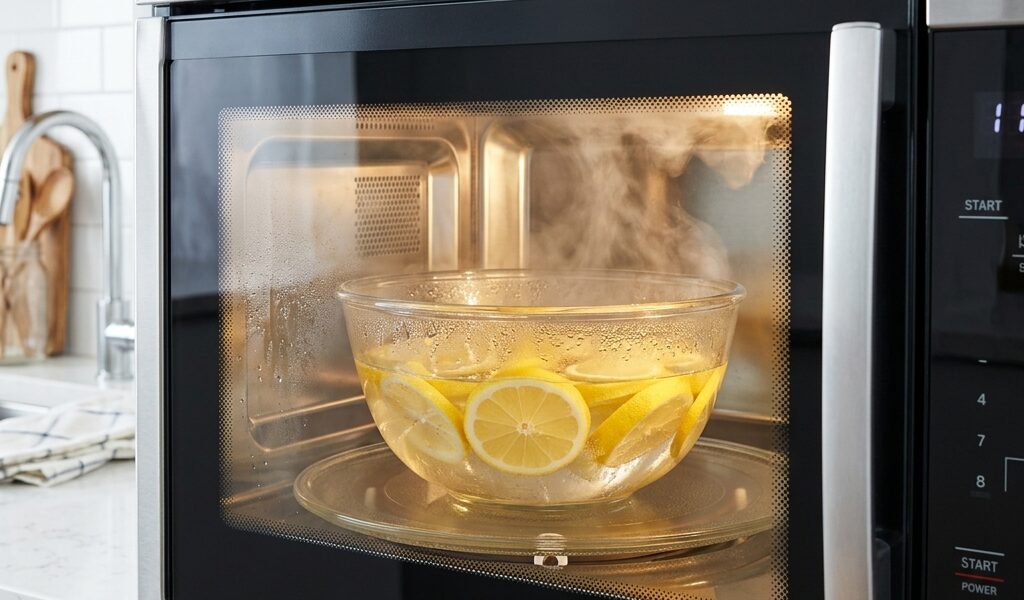
In the field of eco-friendly home maintenance and the transition toward a zero-waste lifestyle, the kitchen is often the arena of a relentless battle against caked-on food residues. Among the appliances most exposed to grease splatters and carbonization, the microwave oven holds a primary position. Splashes of tomato sauce, melted cheese, or various soups accumulate rapidly, forming a stubborn layer of dried-on soil under the effect of recurring electromagnetic waves. Confronted with this household challenge, using corrosive chemical products or synthetic detergents—often rich in irritating surfactants and artificial fragrances—is no longer a necessity. A natural, highly economical, and disarmingly simple alternative consists of exploiting the joint power of water and lemon peels. In just three minutes of active heating, supplemented by a short phase of passive condensation, this method makes it possible to loosen and remove the most stubborn dirt without any scrubbing effort. But how can such a simple recipe compete with the most aggressive industrial formulations? This article details the underlying physical and chemical principles that explain this formidable efficiency, while sharing a rigorous and practical hands-on experience.
Quick Answer
Cleaning a caked-on microwave with water and lemon peels is an exceptionally effective, eco-friendly method that relies on four complementary physical and chemical actions. By boiling 150 ml of water containing lemon peels for 3 minutes at maximum power (800-1000 W), you generate a dense water steam that condenses on the cold walls of the oven. This warm moisture hydrates and thermally softens the stuck-on proteins and lipids. Simultaneously, the heat causes a hydrodistillation of the d-limonene contained in the lemon’s flavedo; this volatile monoterpene deposits on the grease and acts as a powerful non-polar solvent to dissolve it. Additionally, the traces of citric acid present facilitate the chelation of mineral deposits and limescale. A simple wipe with a microfiber cloth is then sufficient to clean the appliance without scrubbing, leaving behind a pleasant scent of natural freshness.
Scientific Explanation
To understand the accelerated decontamination and degreasing of a microwave enclosure by this process, it is necessary to dissect the thermodynamic and chemical phenomena occurring during the heating cycle. The process revolves around four distinct biophysical mechanisms: water steam condensation, thermal softening of biological macromolecules, solvent dissolution by d-limonene, and mineral chelation by citric acid.
1. Steam Condensation and Thermal Transfer
Heating water in a microwave oven occurs through the excitation of water (H₂O) dipoles under the influence of an electromagnetic field oscillating at a frequency of 2.45 GHz. This molecular agitation causes a rapid temperature rise up to the boiling point. Water then transitions from the liquid phase to the gas phase, saturating the air inside the closed microwave cavity. The interior walls of the appliance (often made of stainless steel or enamel) are at an initial temperature significantly below the dew point of the moisture-saturated air. Consequently, the water steam undergoes film or dropwise condensation on the surface of the walls.
This exothermal phase change releases the latent heat of vaporization of water (approximately 2260 kJ/kg). This massive and localized thermal transfer instantly raises the temperature of the caked-on food residues. Furthermore, the condensed water penetrates by capillarity and molecular diffusion into the dehydrated matrix of the soils, initiating their rehydration and breaking the weak intermolecular bonds that bind them to the enamel or stainless steel surface.
2. Thermal Softening of Lipids and Denaturation of Proteins
Kitchen soils are primarily composed of proteins (from dairy products, meats, or eggs) and lipids (oils and fats). In a dry and cold state, these macromolecules form a highly adherent solid network. The thermal input of the hot water steam induces crucial phase transitions:
- Lipids: The saturated and unsaturated fatty acids making up the fats have varying melting temperatures. Exposure to a temperature close to 60°C to 80°C causes the melting of solid triglycerides, considerably reducing the viscosity of the lipid phase, which transitions from a semi-crystalline state to a mobile fluid state.
- Proteins: Under the combined effect of heat and water, polypeptide chains undergo thermal denaturation. The hydrogen bonds and hydrophobic interactions that maintain the tertiary structure of the proteins are disrupted. This conformational unfolding, combined with hydration, transforms the rigid protein matrix into a highly hydrated and loose gel, reducing its mechanical adhesion to the metallic substrate of the oven.
3. D-Limonene: A Volatile Non-Polar Solvent
The true chemical catalyst of this method lies in the lemon peel, specifically in the flavedo. This superficial layer houses oil glands rich in essential oils, whose primary constituent (between 90% and 95%) is d-limonene (1-methyl-4-(prop-1-en-2-yl)cyclohexene). D-limonene is a hydrophobic, non-polar cyclic monoterpene.
During the boiling of the water-peel mixture, d-limonene is carried by the water steam according to the principle of hydrodistillation (or steam distillation). The total vapor pressure of the heterogeneous mixture (water + limonene) reaches atmospheric pressure at a temperature below the boiling point of each of the pure components. D-limonene therefore evaporates at approximately 95°C-98°C and is transported by the water steam throughout the enclosure. Upon condensing on the cold walls, d-limonene and water form a transient micro-emulsion directly on the soiled areas.
By virtue of the chemical solubility rule “like dissolves like,” the non-polar d-limonene instantly penetrates the softened lipid phase of the soils. It acts as a green organic solvent, weakening the Van der Waals forces between grease molecules. Limonene reduces the surface tension of the greasy soil, allowing its solubilization and complete detachment from the smooth wall.
4. Citric Acid as a Chelating Agent
Although the peels mainly contain hydrophobic terpenes, splashes of lemon juice (containing citric acid) inevitably mix with the water during preparation. Citric acid (2-hydroxypropane-1,2,3-tricarboxylic acid) is a weak tricarboxylic acid. In aqueous solution, it acts as a multidentate ligand capable of forming highly stable coordination complexes with divalent metal cations, particularly calcium (Ca²⁺) and magnesium (Mg²⁺), present in hard water or dried food residues. By capturing these ions, citric acid converts insoluble salts into water-soluble chelates, facilitating the removal of white evaporation spots and mineral scale residues encrusted on the inner walls of the microwave.
The simplified chemical equation for calcium carbonate dissolution in the presence of citric acid can be represented as follows:
CaCO₃ (s) + 2 C₆H₈O₇ (aq) → Ca(C₆H₇O₇)₂ (aq) + CO₂ (g) + H₂O (l)
This chelation (or sequestration) reaction destabilizes the calcium bridges structuring certain organic and mineral deposits. By binding calcium, citric acid disrupts the cohesion of the calcified deposits, making them easily rinseable with water.
Hands-on Experience
To scientifically validate this protocol, I conducted a comparative test on a household stainless steel microwave that had not been cleaned for several weeks. The appliance showed significant, carbonized splatters of bolognese sauce (rich in fats and acidic lycopene), as well as solidified melted cheese residues on the ceiling and the glass turntable.
The implementation protocol was as follows:
- I used a heat-resistant borosilicate glass bowl (Pyrex type), into which I poured 150 ml of tap water.
- I peeled the zest of an organic lemon using a peeler, making sure to keep a maximum of flavedo (the yellow part rich in essential oils) and also squeezing a few drops of juice into the bowl.
- The bowl was placed in the center of the microwave, and the appliance was programmed at a power of 850 W for a duration of 3 minutes.
During the active heating phase, I observed through the glass window the rapid formation of steam and the condensation trickling down the walls. At the end of the 3 minutes, I deliberately left the door closed for an additional 5 minutes. This cooling phase is crucial: it allows the enclosure to function as a passive condensation chamber, maintaining a relative humidity close to 100% and prolonging the contact time of d-limonene and water with the greasy residues, while lowering the temperature of the walls to prevent any risk of burning during wiping.
Upon opening the door, an intense and pleasant lemon scent emerged, instantly replacing the unpleasant odors of burnt food. For the actual cleaning, I used a simple microfiber cloth dampened with warm water. The result was spectacular: the bolognese sauce splatters and cheese residues, previously hard as stone, wiped away in a single pass without any scrubbing or the use of an abrasive sponge. Even the ceiling of the microwave, which is usually very hard to reach and prone to baked-on grease, was cleaned effortlessly. The stainless steel walls regained their original shine, free from any limescale or dull film, proving the effectiveness of the volatilized citric acid and d-limonene.
Conclusion
Using lemon peels and water to clean a dirty microwave transcends the simple status of a grandmother’s trick to establish itself as a highly engineered physical and chemical process. By synergistically combining the thermal condensation of steam, the softening of fats and proteins, and organic solubilization by volatile d-limonene, this method eliminates the need for harmful synthetic detergents and plastic bottles. Fast, cost-effective, and 100% biodegradable, it fits perfectly into a modern zero-waste approach, combining environmental respect with absolute household efficiency.