Sucre au zeste de citron : l’astuce facile pour parfumer vos desserts d’avance
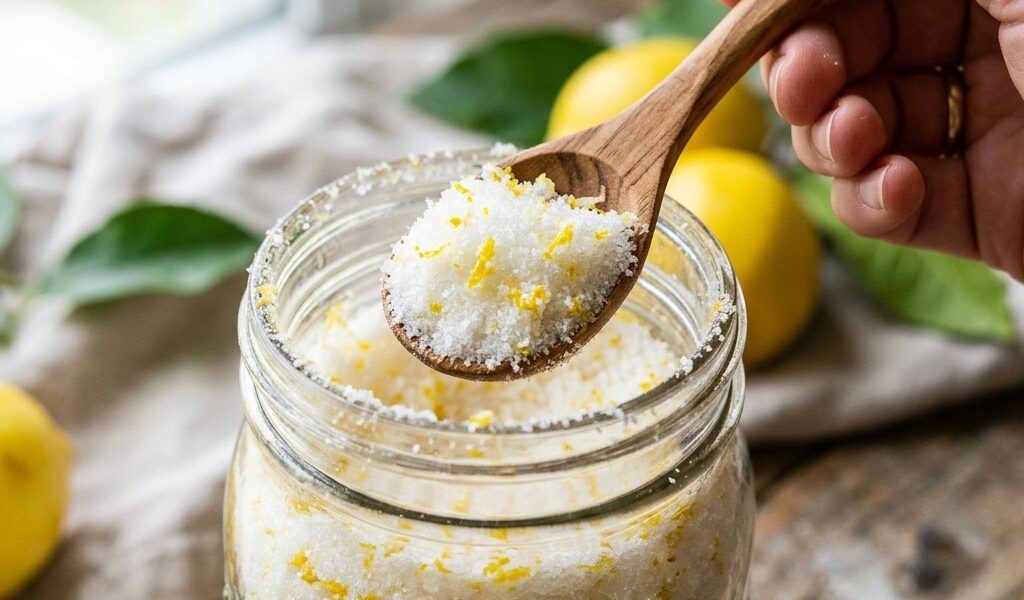
Lemon zest sugar is one of the simplest and most effective base preparations that every amateur or professional pastry chef should master. This process, which consists of macerating grated lemon zest in granulated sugar for a few hours or days, produces a flavored sugar of an aromatic intensity far superior to that of fresh zest added at the last minute. It is a direct application of the phenomenon of essential oil absorption by sugar crystals, which act as true aromatic sponges.
This technique offers a dual advantage: it allows for the preparation of a stable, long-lasting aromatic enhancer in advance, and it optimizes the release of aromas in preparations by ensuring a homogeneous distribution of lemon terpenic compounds throughout the batter, cream, or meringue. It is a professional trick found in many Michelin-starred kitchens.
Quick Answer
To make lemon zest sugar: mix the finely grated zest of one organic lemon with 100g of granulated sugar, kneading by hand for 1 to 2 minutes to release the essential oils. Allow to rest covered at room temperature for 24 to 48 hours (or at least 2 hours for immediate use). The sugar absorbs the essential oils from the zest and becomes a powerful natural flavoring. It keeps for up to 1 month in an airtight jar. Use it as a direct replacement for regular sugar in your recipes for an aromatic result 3 to 5 times more intense.
Scientific Explanation
The aromatization of sugar by lemon zest is based on the diffusion and absorption of hydrophobic volatile compounds (essential oils) into the crystalline matrix of sucrose. Sucrose crystals are ordered molecular structures presenting hydroxyl (-OH) groups from the glucoside rings on their surface. These polar groups have a moderate affinity for amphiphilic molecules like terpenic aldehydes (citral), whose carbonyl function allows non-covalent interactions (weak hydrogen bonds, van der Waals interactions) with the crystalline sugar surface. Hydrocarbon monoterpenes (limonene, beta-pinene), on the other hand, are purely nonpolar and interact with sugar primarily through physical occlusion in the interstices between crystals.
The initial hand-kneading is a crucial step: it mechanically ruptures some of the still-intact secretory cells of the flavedo in the grated zest, releasing a greater amount of essential oils that coat the sugar crystals. The maceration period then allows the progressive diffusion of aromatic molecules by concentration gradient from the zest (high concentration of essential oils) to the sugar crystals (initially low concentration). The partial vapor pressure of volatile compounds at room temperature is low enough that loss through volatilization is minimal if the container is kept closed.
When this flavored sugar is incorporated into a cake batter or cream, the aromatic compounds adsorbed onto it are released progressively as the sugar dissolves in the aqueous phase of the preparation, ensuring a far more homogeneous aromatic distribution than fresh zest added at the end. Baking then releases the remaining aromas and partially fixes them through Maillard reaction with the mixture’s proteins.
Hands-on Experience
I prepare lemon zest sugar in large quantities, stored in airtight jars, and use it as the base sugar for all my lemon-forward pastries. The difference in result compared to simply adding fresh zest is clearly perceptible: the flavored sugar produces a softer, deeper, and more persistent lemon note on the palate, without the zest fragments that can create texture points in a smooth cream.
My favorite variation: equal parts of organic lemon and orange zest to create a citrus sugar of remarkable aromatic complexity, ideal for madeleines, financiers, and white chocolate ganaches. For optimal preservation, I add the spent zests (after their moisture has been absorbed) into the sugar jar: they continue to flavor the sugar for several additional weeks.
Conclusion
Lemon zest sugar is a base preparation of disarming simplicity and remarkable aromatic effectiveness. Based on solid physicochemical principles of essential oil absorption by sucrose crystals, this professional technique allows you to always have a high-quality natural flavoring on hand, ready to use and of far superior intensity to fresh zest used alone. It is one of the most cost-effective preparations in terms of effort-to-result ratio in pastry making.