Homemade Lemon Extract: Make It Yourself with Lemon Zests and Vodka
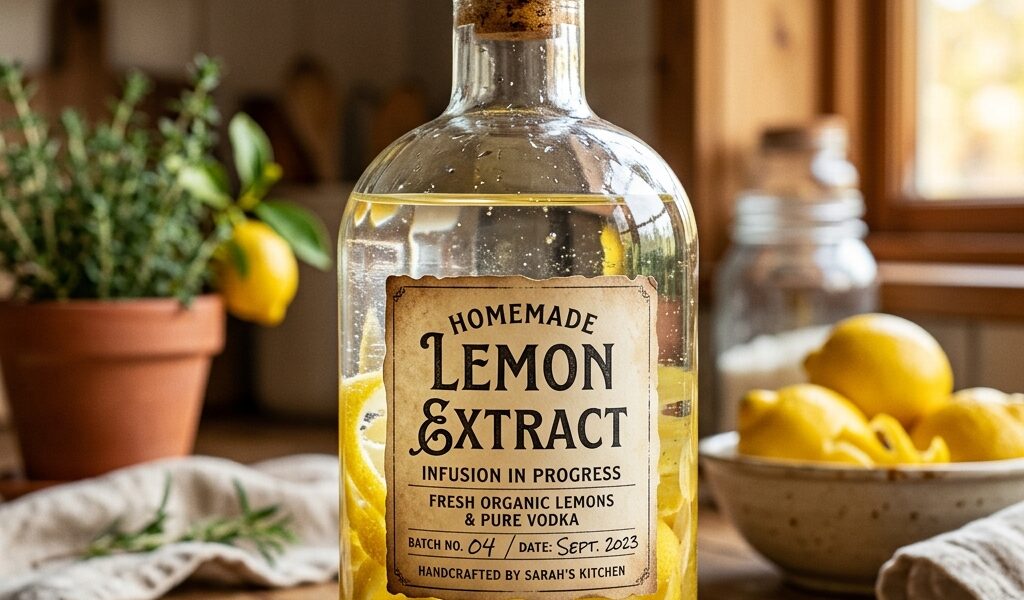
Lemon extract is an indispensable ingredient for flavoring cake batters, accompanying creams, frostings, or cookie doughs. A few drops are enough to bring a bright, fruity note without altering the consistency of the mixture or introducing excess water. Unfortunately, commercial lemon extracts in supermarkets are often of poor quality. They frequently contain synthetic flavorings, artificial colorings (tartrazine yellow), and stabilizing agents, or are sold at exorbitant prices for tiny bottles. Making your own homemade lemon extract from fresh peels and vodka is a simple, economical, and infinitely more flavorful solution. It ensures you get a 100% natural extract with a fragrance of incomparable purity.
Making an extract relies on a physical process well known in organic chemistry: solvent extraction. The aromatic molecules located in the glands of the lemon skin must be transferred into a liquid carrier. To succeed in this extraction in an optimal manner, the choice of solvent and the maceration conditions (duration, temperature, exposure to light) are fundamental. We will scientifically analyze this process to provide you with the most effective manufacturing method possible, guaranteeing a stable and powerful extract.
Quick answer
To make your homemade lemon extract, grate the zest (flavedo only) of 5 to 6 well-washed organic lemons. Place these zests in a clean glass jar. Pour 250 ml of neutral 40% ABV vodka over them, ensuring all zests are completely submerged. Seal the jar tightly and let it macerate in a cool, dark place (such as a closed pantry) for 6 to 8 weeks. Shake the jar vigorously once or twice a week. Once the time has elapsed, filter the mixture using a paper coffee filter and transfer the resulting extract into a small tinted (amber) glass bottle.
Patience is the key to this recipe. The molecular extraction process takes place slowly. If you filter the extract after only two weeks, the fragrance will be incomplete, green, and dominated by alcohol. After six weeks, the sharp notes of the alcohol fade away to make room for the round, fruity, and fragrant character of the citrus essential oils, which have by then saturated the solvent.
The Scientific Explanation
From a thermodynamic perspective, the maceration of lemon zest in alcohol is a solid-liquid extraction (or leaching). The goal is to dissolve the solute (the essential oils contained in the secretory pockets of the flavedo) into an extracting solvent. Ethanol (pure alcohol) is the perfect solvent for this task due to its amphiphilic chemical structure. The ethanol molecule (CH3-CH2-OH) has a hydrophobic, nonpolar ethyl chain, as well as a polar, hydrophilic hydroxyl group. This dual nature allows it to dissolve very polar molecules like residual sugars or acids, but most importantly, highly nonpolar and hydrophobic molecules such as monoterpenes (d-limonene, g-terpinene) and monoterpene aldehydes (citral).
The choice of a 40% ABV alcohol (such as standard vodka) is scientifically optimal. Such a mixture contains approximately 60% water and 40% ethanol by weight. Water acts as a swelling agent for the cellulose and pectin matrix of the zest, increasing the porosity of the plant cell wall. This facilitates the penetration of ethanol into the oil-secreting channels. If a stronger alcohol were used (such as 96% pure neutral spirit), the dehydration of the cells would be too rapid, causing the tissues to shrink and trapping a portion of the aromas inside. Conversely, an alcohol that is too weak would not contain enough ethanol to dissolve the d-limonene, which would eventually phase out and float on the surface as insoluble droplets.
The mass transfer kinetics also depend on concentration. According to Fick’s first law, the diffusion flux is proportional to the concentration gradient between the solid and the liquid. This is why the jar must be shaken regularly: it helps renew the solvent layer in direct contact with the zest, avoiding local saturation and maintaining a maximum extraction rate. Finally, protection against light is crucial. Citral (geranial and neral) is an extremely photosensitive molecule. Under the action of ultraviolet (UV) radiation, it undergoes cyclization and isomerization reactions leading to the formation of p-cymene and oxidized terpene compounds. These new compounds have an unpleasant olfactory threshold recalling kerosene or burnt plastic. Storage in a dark cupboard and the use of amber glass bottles are therefore essential to preserve the integrity of the aroma.
Practical feedback
We conducted comparative tests in our culinary laboratory to evaluate the impact of the type of alcohol used and compare the effectiveness of our homemade extract against commercial mass-market products.
For the alcohol study, we prepared four maceration jars with the same weight of lemon zest (50 grams per 250 ml of liquid) using: vodka (40%), white agricultural rum (50%), gin (40%), and neutral pharmaceutical alcohol (90%). The jars macerated for 8 weeks.
The neutral alcohol (90%) batch proved too aggressive to the nose, with an intense alcoholic burning sensation that masked the lemon. The white rum batch offered an interesting fragrance, but the warm, sweet notes of sugar cane dominated the aromatic profile, masking the fine freshness of the citrus. The gin batch had resinous juniper notes that married well with the lemon but denatured the neutrality sought for a universal extract. The vodka batch turned out to be the clear winner: vodka, being a neutral spirit by definition, captured the pure aromatic profile of the lemon in a completely transparent manner, without adding any interference.
Next, we tested our homemade vodka-based lemon extract in making a pastry cream, comparing it to a common commercial brand extract. The commercial extract, with its artificial neon-yellow color, gave the cream a very chemical taste resembling cheap sour candy or dish soap. In contrast, two teaspoons of our homemade vodka extract gave the pastry cream an extraordinarily rich, soft, complex, and natural lemon flavor, reminiscent of traditional lemon meringue pie. The alcohol largely evaporates under the heat of the hot cream, leaving behind only the fragrant oils.
Conclusion
Homemade lemon extract with vodka is an ingredient of choice for all discerning bakers. Its manufacture relies on simple principles of solvent extraction. By using a neutral 40% alcohol like vodka, respecting a maceration time of 6 to 8 weeks, and storing the extract away from light, you will obtain a natural flavoring of a culinary quality infinitely superior to commercial products.